Tuesday, January 15, 2019

Let's Go (So We Can Get Back) by Jeff Tweedy

Jeff Tweedy is the frontman of alt-country group Wilco. I had the privilege of seeing Wilco at Pori Jazz a few years ago here in Finland. The group almost never comes this far north, but the Finnish summer did not relent even for them. It was barely 10 degrees outside and occasional rain guaranteed that unprepared festival goers were regretting showing up. I made my way to the front of the stage barely ten minutes before the band walked on. After a few songs, a rainbow broke out over the festival area and Tweedy made a joke about singing sad songs in the rain. Overall, it's one of my favorite concert experiences.

Now, Tweedy has written an autobiographical novel and complemented it with a companion album, Warm. For the Wilco fan, this is as good or even better than the band releasing a new album. Tweedy has always been the emotional center of the group and in Let's Go he recounts his life all the way from his childhood to the present day. Wilco, however, is not your average rock band. They've always been closer to a jam band than The Rolling Stones and this shows in Tweedy's light touch with the pen on both album and book.

Let's Go is really funny. I was chuckling mid-sentence several times, to the annoyance of my wife, who was trying to nap next to me. Tweedy has an off-handed way of writing that is in stark contrast to his songs, which can be musically complex and lyrically inscrutable. Early days Wilco was known for setting the bar extremely high in the recording studio, but Tweedy has since matured and loosened up and this is in full effect in his writing. He transcribes conversations between him and his wife into parts of the book, which - coming from someone else - could appear half-baked. Here, however, these passages are some of the most entertaining and heartening in the whole book.

Tweedy may not be the most trustworthy source for everything, though. He subscribes to radical honesty and describes his comfort level with being vulnerable a "superpower", but some passages raise questions about wilful forgetfulness. Tweedy coolly fired original drummer Ken Coomer via phone after stumbling on Glenn Kotche. He admits to his mistake in handling the incident, but devotes less than a paragraph to it. The same goes to his falling outs with fellow band members and Jays Farrar and Bennett. The way he tells it, neither was his fault and both men abandoned the band due to their own demons. But it's hard not to imagine the other side of the argument.

In contrast, Tweedy is painstakingly open about his opioid addiction. He stole morphine from his wife's ailing mother. He disguised his addiction behind migraines, which he did really have, and hid the truth from his wife, who found out only once an acquaintance, who was more familiar with opioid misuse, pointed out that her man was a junkie. Incredibly, all of this can be heard on the album A Ghost is Born, which was recorded during the worst part of Tweedy's addiction. His voice is uncharacteristically bland and forgettable and the songs lack the charm of Summerteeth or the quirks of Yankee Hotel Foxtrot. It's impossible to listen to the album now without hearing Tweedy's addiction in each song and he admits as much. Spiders (Kidsmoke) was recorded in just two takes, because that was all Tweedy could get the energy for.

Tweedy outlines his life after recovering from addiction in a way that lends additional context to the music he has recorded since. Many of his albums after A Ghost is Born have received less critical acclaim, but the truth is that they were not meant to. Tweedy has consciously lowered the bar for his musical output to focus more on his family. Yankee Hotel Foxtrot may have been the global experimental breakthrough, but Sky Blue Sky (and the song Sunday Morning) are unforgettable pop epics. They mark another turn in a musical career that has spanned over three decades.

Monday, January 14, 2019

The Pigeon Tunnel by John Le Carre

2018 may look like the year I read the least books in the history of this blog (just 10 entries dated last year), but it's far from the truth. First of all, I finished a record three books during a Christmas holiday in South Africa, the reviews of which have been on my backlog for the past two weeks. The real number for last year is probably 13; over one book per month. Second, last year included some of the longest books that I've ever read - 4 3 2 1 by Paul Auster and Hamilton by Ron Chernow - which definitely set me back in pure numbers but contributed to a total page count that is most likely way above my yearly average. Karl Ove Knausgård may have dampened my enthusiasm for the long form, but 2018 was a success in terms of page volume.

The books themselves were great too. Many of them had a profound impact on me and a few have been in my thoughts ever since. The Pigeon Tunnel from spy-thriller veteran John le Carré was refreshing and charming, but probably not among the books from last year that will keep me up at night in the future. Le Carré is best known for the cold war espionage of The Spy Who Came in from the Cold and Tinker Tailor Soldier Spy, which I've previously featured. His CV is impressive as is the number of film and TV adaptations that have been made from his books. These books seem like they were written by a confident auteur; someone who could bend people and words into new shapes and surprise readers with intrigue built on the frailty of man. The Pigeon Tunnel shows an altogether different side of le Carré (or David Cornwell, his real name). His prose is still pristine, but the person behind it is much more nuanced.

The Pigeon Tunnel is a collection of anecdotes from Cornwell's life. Some focus on the real world inspiration for his best known characters. Others recount his travels abroad and meetings with world leaders. The longest one, and the last chapter in the book, is devoted to his father, a confidence man and criminal, who's lies and vagary left le Carré permanently seeing two sides to people in his life: the one they try to show you and the one they don't. In these stories, Cornwell is insecure but warm and describes his journeys more through the lens of his constant conviction that he is way out of his league. There are parallels to Bruce Springsteen's autobiography: a man driven to entertain by an absent father and a sense of not doing enough.

In addition to the harrowing tales of his father's misdeeds, I was most struck by an acute generational gap between me and Cornwell. A battalion of cold war diplomat-spies was unleashed on the world with the overt goal of stopping communism. Behind this laudable facade, however, not much was done to the general benefit of western countries and Cornwell admits as much. Young diplomats would attend lunches and dinners, interview locals and file reports that may or may not have had as much informational value as the local newspaper. In reality, the western intelligence community tricked itself better than it could trick the opposing spy agencies. In today's world, the same spies would compete to work 60 hour weeks and write elaborate reports: meaningless work done exceptionally well.

It is difficult to pin down what The Pigeon Tunnel is about. Cornwell's life is better told in a sanctioned biography. The le Carré novels do a better job of animating the cold war. It is not a autobiography by any means; the stories are too vivid and wonderful to be assumed unenhanced by their masterful author. As part of the oeuvre, The Pigeon Tunnel is more evidence to the writer's skills in semi-retirement. In itself, it's impossible to recommend to non-fans.

Thursday, November 15, 2018

High Fidelity by Nick Hornby


High Fidelity, the movie, has somehow become a sort of comfort food for me. I watch it every now and then, and even though it's become exceedingly familiar, it continues to entertain. It seems the same may be happening for the book version. This was the second time I read the Nick Hornby novel, which, I guess, makes for a total of almost ten repeats of book and movie. High Fidelity is up there with The Truman Show for entertainment that I have yet to tire of. There is nothing wrong with repetition, but there is some irony in going back to reread books about being afraid of moving on in life.

Rob is a music geek who, with a pair of attendants, one anodyne and one aggressively insecure, runs a low-key used record store in London. His store is losing money and, as the story opens, his girlfriend Laura has left him for the guy upstairs. In an effort to understand why he keeps striking out with his loves, he tracks down his "top five" breakups, starting from high school. To exercise his demons, he hooks up with an American musician, because he (and I'm quoting from memory, either book or movie) "had always wanted to sleep with someone who had a recording contract". Along the way, Rob has to contend with his insecurities and learn to be a decent human being. Hornby's tone hides the fact that the main character is a genuine jerk for most of the time and, once the realization hits the reader, it's a nice way of realizing how immune we are to bigotry when the bigot is us.

It's a Nick Hornby novel, so the characters have whimsy and depth and the plot is gentle, but a little preachy. It shares a space with other contemporary fiction, like The Martian and The Cuckoo's Calling, that is approachable, funny and moderately well reviewed by critics. It doesn't take itself very seriously, which all but precludes it from winning a Pulitzer or making it to any best-of-the-decade lists. But in terms of quality - of writing, character development, insight or tone - High Fidelity is an excellent work and not to be dismissed.

It's difficult for me to talk about High Fidelity, the novel, in isolation and without reference to my beloved movie adaptation. While I was reading, I could hear John Cusack's voice speaking the part of Rob and Jack Black singing Let's Get It On. Some of the lines are shared word for word between the two medias. At times it seems like the movie is more a reading of the source material - it even shares some of the music references! High Fidelity has been there to support me through several stages of my life. In adolescence, I could sympathize with the terrible breakups. Now, as an adult, I'm more a sucker for the "Where is all this going?" -part. I keep finding new levels.

Tuesday, October 30, 2018

A Man in Love by Karl Ove Knausgård

I read the first part of Knausgård's My Struggle series a few years ago. I had every intention of moving on to the second part immediately, but there was something to the opening pages of A Man in Love that put me off. I put reading the book on hold indefinitely. Now, I suddenly felt that I was ready to face the familial themes of Knausgård's autobiographical work. The book opens with a passage, where Knausgård takes his first child to the playground with his wife. In all its ordinariness - I even struggle to remember the exact contents - it's a great introduction to a book about love, lust, morals, family and masculinity that is tied to the world of early 2000s Sweden.

The strangest thing about Knausgård's novels has been that they make me distinctly bored at times, and not for insignificant amounts of time. In A Death in the Family, a new year's foray to a friend's party seemed to drag on forever. In this one, discussions of German philosophy could cause an onset of somnambulism. Yet, both books have been immensely rewarding all the same. The slower pace of his novels forces the reader to sit down for longer periods and adjust their rhythm to the pace of the writing. There is an element of victorian drama to it all: when everything is deliberated and considered, and the drama plays out in chapters and not paragraphs, even the slightest changes in tempo have an immediate impact on the reader.

Part of what makes A Man in Love, and all of the other books in the series, magical is the way they subvert your expectations without leaning on tropes or plot twists. Most other novels are built around traditional drama rules, things that you would learn in art school or drama class. If a gun is introduced, someone must pull its trigger. Emerging love interests need to be resolved or rebuffed. Tension is built up, then released. A Man in Love adheres to none of these. Drama unfolds as it does in the real world: conflicts are left unresolved and motivations are either left unexplained or are unexplainable. It takes some time to get used to this and as the novel plays with your expectations of what can happen in drama, it gets under your skin.

Nowhere is this more evident then when Knausgård takes his daughter to a toddler music class. He sits among mothers with their children, chanting silly nursery rhymes and feeling emasculated. Anger builds up inside him, because he is unable to act on his instinct to make an exit. He feels humiliated in front of the attractive instructor, a young woman that barely acknowledges him. He wonders if he could make advances on her after class. A scene like this would have some cogent resolution in ordinary fiction. But here, nothing happens. Knausgård and the instructor never speak or see each other again. He doesn't charge off cursing.

The sixth and final part of Knausgård's saga was released in English a few months ago and many reviewers mentioned the previous books, especially A Man in Love, as some of the greatest novels of the 2000s. Personally, I'm a bit torn. I haven't actually finished it yet and I'm stuck a few dozen pages before the end. Then again, I already feel that both A Death in the Family and A Man in Love have had an outsized impact on me as a human. I adore books that get in the reader's head, and both novels do that without a hint of trickery. It reminds me of Andreas's effect on Pip in Jonathan Franzen's Purity. Knausgård has power over the reader because he is present more in their brains than on the page. He has charisma, looks and a prickly personality. Keeping him in check is part of the struggle.

Wednesday, September 12, 2018

The Last Wish by Andrzej Sapkowski

I'm even a little embarrassed to be posting this, but I feel it's more important to be honest than to hide something that I actually read. The reason for my embarrassment is insignificant but perhaps a little revealing. The Last Wish is a collection of short stories set in the world of The Witcher trilogy of video games. The books came first and the video games later, but that makes neither no less nerdy nor suspect. Sci-fi and fantasy have been making more excursions into the pop culture world - just consider how big Game of Thrones has become - but the connection is still mostly held together by couplets of video game and book or movie and book. Without its game counterpart, The Last Wish would languish in book shops among hundreds of similar looking fantasy romps, exotic elves or glistening swords or dragons adorning their covers.

That is not to say that The Last Wish is all bad. Its decidedly more mature than typical teenage fantasy books (which is not the only thing it has in common with Game of Thrones). Some of the short stories are genuinely good (especially The Lesser Evil and The Witcher) and they make use of the format's strengths: the increased weight of every line of dialogue, the opportunity to focus on smaller themes and the natural tension of wondering how each story will end. Sapkowski does a good job of giving characters personality even within the confines of individual chapters and the individual stories add to the others as well, as the reader starts to understand Geralt's, the main character's, predicament.

I would never had given The Last Wish the time of day, if I hadn't enjoyed The Witcher 3 video game so much, it's as simple as that, and having read it, it seems unlikely that I'll read any of the four other novels in the series. I couldn't shake the feeling that there is little of consequence in the world of The Witcher. How am I the wiser having read this? The Last Wish didn't really surprise me, nor did it delight me. It's good, but it represents a genre that I tend to categorically discount. It may be beloved in its original Polish, but some of the context is clearly lost in regions that are not familiar with what kind of fairytale monster a striga is. Geralt isn't your average monster slayer, but he isn't that unique either. In the books, at least.

Thursday, August 16, 2018

The Woman in the Window by A. J. Finn

Summer reading is supposed to be fun and The Woman in the Window is fun, for the most part. At the same time, though, its derivative, predictable and repetitive. It follows the tradition of recent summer romps like Gone Girl and The Girl on the Train so closely that despite the pristine prose, I kept feeling cheated: it takes a lot of convincing to show a skeptic like me that this isn't just some calculated effort to run down a trend. Even Daniel Mallory's pseudonym, A. J. Finn, is so similar to Gillian Flynn (author of the much better Gone Girl) that you can't help feeling a little duped. And what's wrong with his own name in the first place? To me Daniel Mallory is a perfect novelist name, albeit a male one that might not look as convincing on the cover of a book about a woman aimed towards women in general.

Anna Fox is an agoraphobic - someone who fears open spaces - and spends most of her time indoors in her town house in Harlem, New York. From her window, she spies on her neighbors with a long lens camera. When she witnesses a murder across the street, she has to deal with her phobia and past trauma to work on finding the killer. The framing of the story is standard Hitchcock by way of Agatha Christie and overall I had a hard time seeing the forest from the referential trees.

Here's a list of references to give you an idea of how The Woman in the Window "pays homage" to other books and movies: almost all of Hitchcock's films (most notably The Rear Window, Vertigo and Strangers on a Train), The Girl on the Train (especially the alcoholism, the voyeurism and the titling),  and perhaps even The Truth About the Harry Quebert Affair (the interactions between an obstinate protagonist and a good-guy cop). These are just the ones that I recognized. The New York Times review is almost exclusively dedicated to describing how The Woman in the Window fits in with the wider tradition. It's more a gala of dignified references than an actual book review.

As a simple summer read, The Woman in the Window is perfectly adequate and I imagine that the obligatory, fast-tracked movie version will be as good or even better. Its above most detective fiction because it is so well built. Pacing and exposition are excellent, the reader is hooked with shocking revelations and a surprisingly humane touch. A mid-book aside about a skiing trip is haunting and a definite highlight. Mallory overdoes the alcohol and prescription drug aspect of Fox's persona, however, so much so that readers of The Girl on the Train are already plenty familiar with the drill. Was the murder just a product of an over-active imagination and unscrupulous use of medication? The answer won't surprise you.

All that being said, there seems to be nothing stopping The Woman in the Window from becoming a success both in print and on film. It makes for perfectly pleasant reading, especially if you haven't seen Vertigo. Its faults will be pointed out by critics, but as a product of today's pop culture, we could do worse. It's the Bruno Mars or Robin Thicke of detective fiction. You can't really complain about production values, but don't be surprised if copyright infringement lawsuits start popping up.

Wednesday, August 15, 2018

Rework by Jason Fried

Rework isn't really a book, it's a manifesto. Sure it's packaged like a paperback, has compelling blurbs to go along and seems like your average management-self-help effort. There's barely any structure, for one, which clearly differentiates it from most of the other management books out there. "Chapters" are more like op-eds, covering a few pages at most and only a few paragraphs at least. Where others try to convince businesses based on scientific (or pseudo-scientific) evidence, Rework relies on sound argumentation, passion and chutzpah.

Many of its core ideas are as valid as ever. Working late nights and weekends is useless and often ruinous. Budgets are guesses. Meetings are (mostly) a waste of time. Companies should sell their by-products. All are excellent guidelines for would-be entrepreneurs and business managers. Even when its arguments are backed up by barely more than an anecdote and a few wise words, Rework is convincing. There is a transparency to making bold statements with limited evidence. Most business books leave you with a sense of being duped; their evidence, often in the form of graphs or cherry picked data, is often too neat and too convincing. Rework shows you its weaknesses and is better for it.

I'm always surprised to find out how much the actual world of work differs from that of Rework. Its ideas are sometimes obvious to the point of banality, yet most companies are unable to implement them. For example, there is no evidence that meetings are suddenly becoming less prominent or their content more engaging. Why are we stuck in this imperfect world? I would like to understand what is actually standing between us and the world of Rework. Is it our inability to question tradition, handed down from previous generations of managers? Is it our overconfidence and hesitance to learn and read? Or is it the surplus of poorly formulated and contradicting management advice? Whatever it is, Rework makes a compelling case for a new era of work.

Thursday, August 9, 2018

Shoe Dog by Phil Knight

Not many are familiar with him, but most of us have bought the products he inspired. Phil Knight is the founder of Nike, the inescapable, all-around sportswear company. Introducing Nike as a sporstwear company feels like introducing coffee as a beverage; there is hardly anyone that has not heard of it. Most of us even have an opinion of its products. The name of Phil Knight, on the other hand, probably won't ring a bell for anyone except the most ardent Nike fans. His face isn't recognizable either. He once ran into Bill Gates and Warren Buffet outside a movie theather and realized that passers-by could only identify two out of the three, even though his personal wealth is on a similar level.

Phil Knight was brought up in the suburbs of Portland, Oregon. At the University of Oregon, he trained under legendary track and field coach Bill Bowerman, who would later become the cofounder of Blue Ribbon, Nike's predecessor. Having graduated, Knight decided to travel around the world to visit spiritual places such as Mount Fuji and the Ganges river. At the same time he dreamed of putting an old business plan in action: importing running shoes from Japan.

The trips to post-war Japan are some of the more memorable parts of an otherwise adequate but not extremely titillating book. Knight took an amazing leap of faith by ordering untested foreign running shoes to import to the United States. He sent most of his money to the Onitsuka company as an advance for his first order. There was no explosive beginning, just a series of years, when Nike grew slowly and struggled to raise cash for growth. First the shoes were sold from Knight's parents' home, then from a small office, then from one store in California. At the time, ordering and producing the shoes was slow, so Knight was constantly on edge, as he waited for the next shipment to arrive.

Shoe Dog is mostly pop culture and meant for casual fans. There is a business book in there somewhere as well. Knight is not an ideal leader, he says so himself, and his gaffs are both heartbraking and hilarious. You can trace his development from a wide-eyed twenty-something into a pin-stripe suited corporate master. As he yells at his colleagues and tries to outsmart his suppliers, you can feel his idealistic past peel off. Whether or not this is intentional, I cannot say. It is this arch from idealism to capitalism that drives the reader's interest. Will he completely abandon his principles at the altar of the goddess of victory?

Friday, June 29, 2018

4 3 2 1 by Paul Auster


I didn't really know what to expect from 4 3 2 1. I went in barely having read the back cover and blurbs. I was on vacation in Sri Lanka, overwhelmed by the sounds, smells and sights of that wonderful island. The paperback was mostly there as a companion to the beach or for relaxing on a long (and sweaty) train ride. Reading on vacation is often a completely different experience than reading under a bedroom light. Vacations are often simultaneously relaxing and draining. You have time to slow down and let your mind rest. At the same time, I can't help myself planning the next stage of the trip or comparing dinner options. As my stress levels went down, I felt more receptive to literary fiction. It was as if work had muted my ability to focus and now as I huddled in my hammock, it had come rushing back. 

Unlike all of Auster's other work, 4 3 2 1 is a massive brick of a book. Instead of telling a single story, it tells one story four times. Archibald "Archie" Ferguson's life begins as one as his immigrant grandfather arrives in New York. His life takes four diverging but concurrent paths through mid 20th century America. For each stage of Archie's adolescence, four (or fewer) different stories are told that trace Archie from school to college and beyond. The reason for these repetitions may seem unclear or without motive at first, but a satisfying - and typically Austerian - conclusion ties up the loose ends nicely. I especially commend Auster for leaving clues along the way that point toward the end without giving it away.

Auster's previous work could sometimes feel like exercises in vanity. His novels would often crowd out character development for the sake of metaphysical themes like chance and subjectivity. His past works would get stuck on topics like black and white cinema, leatherbound notebooks or obscure writers and while that often served a purely literary purpose, they also interfered with the plot. The plot (mostly) takes center stage in 4 3 2 1, which makes it Auster's most conventional and approachable work. This also showcases his previously less visible talents as a storyteller and yarn spinner. 4 3 2 1 is breathtakingly excellent throughout, and without the small hiccups around the middle of the last third, it would be remembered as a masterpiece of the 2010s with the likes of The Goldfinch.

An interesting thing about 4 3 2 1 is that it has immediate rereading appeal, unlike almost any other book that I've encountered (excluding my adolescent fascination with all things Lord of the Rings). Because it is structured around phases in Archie's life, the next logical step would be to read the stories of the different Archies in character-centric order instead of chronological order. Reading four versions of the same adolescence messes with your head in a satisfying way and has readers looking for similarities between the Archie who lost his dad to a fire and the Archie who's father is a misanthropic millionaire. Mixing up the chapters and focusing on one incarnation of our hero would create a series of more conventional mini-novels.

What I loved about 4 3 2 1 was that it doesn't need to cheat the reader to be as good as it is. It's an excellent novel even without the trickery of the multiple Archies. Chapters are vivid but concise as they draw Archie's life in varying contexts. He's rowdy and inspired, then he's gloomy and sexually frustrated and then he's a young author with a name for himself. His parents support him, then they don't. His family disintegrates and then, in other circumstances, it doesn't. All these instances are there simultaneously, creating a comprehensive character study, across a universe of Archies (and Amys, Stanleys, Roses and Celias). It is hard not to be enchanted.

Sunday, May 13, 2018

Alexander Hamilton by Ron Chernow

It's been over two months since the last time I wrote. You would be forgiven for thinking that I had taken a longer leave from reading or had given up all together. It's true that it has been a while since I last read something that really got to me. For the last year, I've sometimes felt that I'm running out of steam. Reading hasn't given me as much joy as before. Those are not the reasons for such a long break, however. I've been inching through two tomes of epic length simultaneously: Ron Chernow's Alexander Hamilton and Paul Auster's 4 3 2 1 (more on that in the next post). Combined, they make up over 2000 pages. When traveling, you can only take one with you, as the combined weight from the two would surely push your luggage over the weight limit or break the seams of your backpack.

Alexander Hamilton is, naturally, the biography of the United States' first Secretary of the Treasury. Born out of wedlock in the West Indies, Hamilton rose to key roles in the American Revolutionary War, the Declaration of Independence and the cabinet of George Washington. After years of hard-fought political battles, Hamilton died in a duel with the Vice President Aaron Burr. More than any of his fellow founding fathers, Hamilton's life was a roller coaster of great heights and astounding lows. Even as he left his indelible mark on the country - writing the Federalist Papers, creating the Post Office, the Coast Guard, the Bank of New York, The National Bank and establishing New York as the center of finance and commerce that it still is today - his legacy has often been shrouded by attempts by his detractors to discredit him.

Alexander Hamilton bears some striking similarity to today's world. The first thing you notice is the utter likeness of the 18th century political world to the current one. Political slander in the 18th century was as vicious as it is today with the confounding factor that key members of the president's circle used pseudonyms to trash talk each other in the press. For example, Thomas Jefferson eagerly spread false rumors that Hamilton vied to create a US monarchy and that he was embezzling money as Secretary of the Treasury. The same conflicts that haunt today's America are there as well: the divide between the rural populace and the cities, the feud between the north and the south and the fear of giving too much power to a central government.

Chernow's book is a wonderful work; an enlightening and engrossing read that isn't afraid to ransack archives to prove a point or unearth some new piece of evidence. His prose is pristine and his personal passion for the topic shines through constantly. Quotes from the time slow down the pace a little, but are a critical component in understanding the era which, despite seeming eerily similar to our own at times, is often bewildering in its beliefs, customs and systems.

The last piece of this puzzle is the extraordinary musical Hamilton by Lin Manuel Miranda. It may be mostly unknown outside of the United States, but it has been a source of endless inspiration for me. I would never have read Chernow's biography, if I hadn't listened to the musical on repeat for the last two years. I am unable to say, which of the two should be considered the main oeuvre and which is more a supporting work. Even as the musical is based on the book, it transcends it in every way. The biography hints at the connection to today's America; the musical blows it wide open. I notice that even in this somewhat lengthy review, I have only said a fraction of the things that I want to say about Alexander Hamilton. His life story is a rabbit hole that ultimately explains the modern world as much as it reveals our history.

Friday, February 23, 2018

Homo Deus by Yuval Noah Harari

It's taken me an unusually long time to find something to say about Homo Deus. I've been struggling to come up with a way of describing it that would both do it justice and elaborate some of my frustrations with it. Just as its predecessor Sapiens, Homo Deus has been received with almost universal acclaim. It has a sense of gravitas and distinction that raises it above many better books. I couldn't quell a feeling of history-in-the-making as I read chapters on the nature of fiction, spiritualism and data, while simultaneously feeling extremely frustrated with Harari's extravagances and general pomposity.

A friend had an accurate description of Homo Deus: if you take everything at face value, you are either extremely gullible or will never finish it. Harari has opinions. You will agree with some and disagree with others. So expecting to read Homo Deus in the same state of mind as you would read something like Alexander Hamilton's biography (as I'm currently doing), will inevitably result in disbelief at the amount of leeway Harari has taken. Parts of Homo Deus recall editorials in science journals and in some ways the book is just several of those strung together.

I've always been a fan of telling stories through examples, and this is where Sapiens and Homo Deus diverge most. Sapiens was a riveting read, because it could enlighten the reader with stories of early humans and modern history. Those stories were the backbone of the book, and served to prop up other, more speculative, parts. Homo Deus is largely devoid of anecdotes, especially toward the end. This is understandable, as Homo Deus has less source material to go on. The future is unwritten, and Harari's goal is to look as far into the future as possible, so theorizing is the more common mode by default.

All this doesn't mean that Harari's message isn't important, even vital. As humans, we are so focused on daily drudgery that slower changes seem not to register. Harari succeeds at taking several steps back and looking at changes that have been brewing for decades or centuries. With the decline of religion and the lure of individualism, humanity has lost its sense of purpose. If there is no god, and humans are mostly (or wholly) algorithms that react to changes in their environment, how can there be free will or meaning. These questions have been posed by others before, but Harari ties them into a larger discussion of where humanity is headed. It is an important, but partly demoralizing debate.

More than with any other book, I struggled to give Homo Deus its due. I absolutely loathed reading some chapters. Harari goes on for pages in the style of "By equating the human experience with data patterns, Dataism undermines our main source of authority and meaning, and heralds a tremendous religious revolution, the like of which has not been seen since the eighteenth century.". As important as the message may be, his prose is too overbearing at times and he can't resist shoehorning in his personal opinions (on meat production, for instance). I struggled to finish it, because of its faults. Yet, I have a feeling that Homo Deus will come to mark an end of an era, as artificial intelligence overcomes human intelligence. As a guide to that future, Homo Deus is the undisputed leader.

Tuesday, January 16, 2018

Selected Short Stories by Philip K Dick

Philip K. Dick may be better known to most for the movies based on his novels. “Blade Runner”, “Minority Report” and “The Man in the High Castle” (among many others) have become staples of the science fiction genre and are known to even the most casual moviegoer. “Blade Runner”, especially, is more than a movie: it launched the career of one of the most recognizable actors of his generation (Harrison Ford) and defined the visual esthetics of science fiction in general. The underlying novels and short stories, while less well known, are classics as well. They are often funnier and stranger than their movie adaptations and work as great companions to the movies they inspired.

The short stories in this collection – compiled expertly by Jonathan Lethem – offer an enticing overview of the author’s work. There is an enviable amount of variety in the stories, but they are not all equal. “Second Variety” and “Impostor” are instant classics. “We Can Remember It For You Wholesale” and “Minority Report” are excellent, but better known as high budget action films (the former was retitled “Total Recall” and inexplicably starred Arnold Schwarzenegger). “The King Of The Elves” and “The Electric Ant” are delightful diversions, but don’t necessarily warrant another reading. Even the weaker chapters – namely “Rautavaara’s Case” and “Roog” – have their own role in the ensemble. They work as asides and transitions between the main material.

What stands out is that each short story has merit on its own, yet the collection adds something to each individual piece. Themes of apocalypse, insanity and the nature of reality are observed from different angles to create a surprisingly compelling whole. “Autofac” and “Second Variety” describe a world, where factories have been automated to produce weapons without the intervention of humans. The quest to win wars leaves all sides on the brink of humanity’s end. The last humans desperately look for respite in a world ruled by apocalyptic wastes and bloodthirsty machines. Yet in spite of the chilling and sometimes gruesome content, Dick has a knack for the absurd. Many of the stories have surprising levity, even as they explore serious topics.

If Ender’s Game mostly attracts nerds and military types, Philip K. Dick has a much wider appeal. The science fiction is mostly there as a backdrop to explore humanity's fears and frailties. His descriptions of future technology with gears and wires, clicking and whirring, may seem quaint in our digital world, but the consequences of that technology are depicted disquietingly. Casual readers will quickly pick up on how, half a decade later, humanity is still on the course outlined in these short stories – only we are closer to their future than ever before.

Friday, December 1, 2017

Ender's Game by Orson Scott Card

Ender’s Game is about preteen boys training to become space commanders. There is no way of getting around that. Unapologetically sci-fi, on the surface, Ender’s Game sounds like a poor episode of Star Trek or one of the fictional novels of fictional novelist Kilgore Trout. Once you get past the silly premise, however, Ender’s Game is a brilliant and pleasingly short epic about leadership, war and the (sometimes necessary?) abuse of power.

Andrew “Ender” Wiggin is a child – 6 years old in the beginning – who is drafted to military school in preparation of a third act in an interplanetary war with an alien species, the “buggers”. The school, a space station in close orbit, was once home to his older brother, who was dispelled for his violent and unpredictable character. Unbeknownst to Ender, he has been deemed the only hope to lead humanity’s starships in a last effort against the threat. He is isolated and humiliated by his superiors in an effort to turn him into a ruthless leader.

Described in this way, Ender’s Game may sound dull, even run-of-the-mill. A recent, fairly average, movie seems to indicate the same thing. Undaunted, I followed a friend’s recommendation to read it with an open mind. Once I got past the implausible seriousness of the children – they sometimes speak as if augmented with an elder statesman implant – I started to enjoy Ender’s Game.

I hugely enjoyed the author’s stylistic choices. Science fiction sometimes gets too tangled in trying to explain all the ways an imagined world is different to the one we live in. Card has chosen to give a minimal amount of description about Ender’s surroundings. For example, the space station is described as a rotating doughnut spinning around a central arena, and it’s corridors slope upward as a result. Beyond that, there is little discussion of what it is actually like inside. Card’s focus is instead on Ender’s mind and the relationships of the school’s boys (and few girls). Readers are given just enough context to fill the atmospheric void. As a result, Ender’s Game has aged extremely well: readers are able to substitute the lack of specificity with technology from the current age.

Another triumph is Card’s way of establishing power in the confines of the space station. Power is distributed unevenly between the children. Platoon commanders are responsible for their troops and suffer that responsibility in different ways. Their subjects rebel, submit and try to subvert their commander’s power. Their power is based on superior age, abilities and ruthlessness, not on their skills as a leader.

Power is explored methodically, inch by inch, in a sequence of escalating events that keep the story moving and genuinely affect the children. Even minor characters have credible story arcs as they are forced to live under new circumstances. Yet, the children are defenseless against the power of the school’s adults, who mercilessly intrude on their lives or stay back even when they would be needed.

In its brief 300 pages, Ender’s Game manages to be a coming-of-age story, a leadership guide and an exploration of war. It is mostly self-contained, although it is the first in a long series of stories from the same universe. I was not so enamored with this world to immediately reach for the next book in the series, but it is not out of the question either. Ender’s Game is part Lord of the Flies and part Starship Troopers – extremely serious, but partly absurd. Card walks that fine line well.

Thursday, October 5, 2017

Purity by Jonathan Franzen (revisited)

Reading something twice creates an interesting second perspective. New details emerge, as the reader is free to let his mind wander through a familiar book. Characters may become more believable, when viewed with the benefit of hindsight. Overall, the story may come to make more sense. On the other hand, a second reading may reveal serious flaws that were missed on the first go. As the reader gains familiarity with the material, the suspension of disbelief that hid the most glaring problems may begin to subside. Often, repeated readings reveal the author’s quirks and weaknesses more than new elements of the story.

Rereading Purity had a bit of them all. There were parts that were more enjoyable, because I could look past the immediate storyline and see how the different puzzle pieces fit together. This is true of most books that are worth a second outing: Slaughterhouse-five, Freedom and (surprisingly) A Clash of Kings.

Franzen has once again created a structure that is closer to Pulp Fiction than to Reservoir Dogs – the narrative doesn’t follow a single character and the chapters are not in chronological order. This was frustrating, when I first encountered it, because you are forced to take on new people and places with each new chapter. However, once I was free of the burden of trying to guess how it all fit in, the individual stories seemed more coherent and pleasing.

That being said, it became clearer why Purity didn’t receive the same praise as Freedom or The Corrections. I was especially disappointed to realize that although Purity ought to be about Pip and her travails in the modern world, it is more concerned with practically anyone else. Above all, Purity is the story of Andreas Wolf, the youth worker who becomes a leaker and exposer of secrets. His character arc is enthralling and, at best, visionary, but he is also the villain in a nonconventional sense. More accurately, he is a psychopath and an asshole. While his demise is satisfying, his actions are not. Compared to Richard in Freedom (who has a similar but less creepy role), he is frustrating and, at times, insufferable. Andreas’s motives are sinister or narcissistic, so even his more noble actions are put in doubt.

So here is my list of gripes after a second reading: Pip is the most interesting character, but is left in a supporting role. Anabel and Tom almost get back together despite having an absolutely ridiculous marriage. Tom helps Andreas hide a body, but it is completely out of his character. There is too much talk about masturbation, perhaps by a factor of five. And someone’s mother gets her own backstory of moving out of Germany, but even after a second round, I still have trouble understanding why it is there and whose mother it was in the first place. But as I’ve mentioned before, Franzen has a way of describing the world around us that has always delighted and inspired me. Purity may not be his best work, but it did keep my attention through a second reading.

Thursday, September 7, 2017

Our Kind of Traitor by John le Carré

John le Carré introduced himself as the de facto spy novelist of the Cold War era. His writing, including The Spy Who Came in from the Cold and Tinker Tailor Soldier Spy (both of which were previously featured on this blog), ousted spies as morally ambiguous, traitorous and amorphous. Pop culture had previously been acquainted with only the daring and adventurous detectives in Dashiell Hammett's work and Ian Fleming's high society spy James Bond. Le Carré introduced spying as the ultimate dirty work, where neither side ends up better off. In his work, good men and bad men were equally likely to be found on both sides of the Berlin wall.

The Cold War ended but espionage and intrigue didn't. Le Carré's work has always been rooted in modern fears and fabrications and so it is with Our Kind of Traitor. A Russian oligarch knows that his end is near and begs two Brits to arrange a new identity for him and his family - his information on the Russian mob in exchange for asylum. The Brits, Perry and Gail, play along uneasily at first, but are drawn into a standoff between Dima, the Russian, and the British Secret Service. Perry and Gail are fooled by their own vanity and end up getting a raw deal. The British Secret Service on the other hand is highly dysfunctional and has fractured into rival groups with conflicting agendas.

Despite an ending that felt too familiar from The Spy Who Came in from the Cold, Our Kind of Traitor is a riveting read. It is a perfectly well crafted spy thriller and I am happy to report that physical violence is kept to a bare minimum. This is not a superhero movie, nor a spy novel disguised as one. The characters, especially those of Hector, the spy master, and Perry, the Oxford lecturer turned envoy, are memorable and robust. Men especially will feel tinges of discomfort when reading about Perry's competitive desires and inability to back down.

Le Carré, as always, is the master of international espionage. Other writers put their weight on creating action and suspense through harrowing escapes, car chases and shootouts. Le Carré has instead perfected the slow build-up. Never have I felt so intimidated by a lone Swiss police officer at a train station in Interlaken, or a suave international businessman with an Italian sounding name, who is always nearby when trafficking and money laundering are discussed. Of course, it is all just as fictitious as the shooting and the racing, but for me this is what spies are really about: cold sweat on your back, neglected loved ones or friends and a pervasive uneasiness with the world around us.

Monday, July 17, 2017

Sapiens by Yuval Noah Harari

Sapiens by Yuval Noah Harari is both a phenomenal origin story of the human race and a frustratingly biased and imprecise look at recent history. In much the same way that Bill Bryson opened up the entire history of the universe in A Brief History of Nearly Everything, Harari attempts to reconstruct the development of Homo Sapiens, including everything from our chimpanzee ancestors to our near future. Unlike Bryson, however, Harari has serious problems in keeping the focus on objective observations - and while that may not have been his initial idea in the first place, it becomes a big problem especially toward the end of the book.

Sapiens is at its best early on, when Harari describes the origin of the different Homo-genus peoples. I didn't anticipate enjoying this part of the story so much. Textbook descriptions of hunter gatherer groups have never been able to capture my imagination in the same way as Harari does here. Not only do these chapters succeed in giving a vivid image of how humans lived at the time, but they also highlight the limits of our knowledge in an approachable and realistic way - much of the evidence of early humans has been lost to time. The early nomad expansions into Australia and the Americas are a fascinating example of the determination of early peoples to find new lands. For example, a few centuries after the first humans reached Australia, almost all of the large mammals of the continent disappeared in one of the worst waves of extinction. Before our arrival, Australia had been home to giant kangaroos and marsupial lions.

The largest issues come later on when, Harari describes the industrial age and the modern world. The way he tries to sum up capitalism and science into neat packets does a disservice to the previous few hundred pages. The latter chapters are less an enthralling revisit of history than the author's attempt to shoehorn his own conceptions into pre-existing theories. It is here that Sapiens loses some of its objectivity and credibility.

At one point, Harari claims that economic growth (and the belief in economic growth) are absolutely necessary for banks to take deposits and lend money. This is either a gross simplification or the author's attempt at Zeitgeist-type sleight of hand. I was able to get a mortgage because the bank knows that I have a steady monthly income that I can use it to pay back. This is in no way related to economic growth or the banks expectations that my salary will increase as time goes on. The bank could lend money even in a declining economy (and they do). Finance works (among other things) by smoothing out the immediate need for cash by guaranteeing income in the future.

I am tempted to overlook Sapiens's problems because it did leave an immediate mark on me. The way it looks at the world is quite unique and it will force readers to question even their most fundamental beliefs. Just remember that Harari indulges his whims a tad too much. As a reader, you don't always have to accept his explanations and assertions. Reading Sapiens, you learn much about early humans that you didn't know would be interesting. And you'll be left with a lingering sense that there is still much to learn about yourself and the entire human race.

Tuesday, July 4, 2017

New York 2140 by Kim Stanley Robinson

In 2140, the global water level has risen over ten meters. Coastlines around the world are swept under in "pulses" of rising water and populations counting in the millions are forced to leave everything and search for higher ground. Lower New York is mostly uninhabitable, except for the old skyscrapers,  the first few stories underwater, that have come to resemble Venice. Meanwhile, north of Central Park, "super scrapers" house the super rich. At the MetLife building in Manhattan, a ragtag cast of co-op inhabitants are forced to cooperate to save their building and perhaps the city.

That's the premise for New York 2140, a science fiction (or perhaps "climate fiction") piece by Kim Stanley Robinson. I picked it up, to be honest, because The Verge, a technology website, recommended it. It seems that I've been on the receiving end of book suggestions lately, and so far it's been great!

It's a nice read, but I was a little surprised by what felt to me like a lack of consistency in some of the narratives. Not all of the characters seemed to be acting in a logical way and some of the story choices felt contrived. For example, much of the story revolves around the mysterious disappearance of two young programmers, who had been working on some kind of stock market fix that could end inequality and restore fairness to the economic system. The exact nature of their disappearance is duly explained, but I never understood what it had to do with the rest of the story. A large scale conspiracy is behind most of the events, but it isn't entirely clear how. And most of the conspirators are acting behind the scenes and only mentioned by name in dialogue. The reader is left to imagine the villains based on very limited details.

Luckily, the conspiracy part isn't that important to enjoying New York 2140. Characters like Inspector Gen and Franklin are entertaining and compelling individuals, whose chapters were clear highlights. The dialogue is consistently great - it has wit, charm and keeps the pace wonderfully - and the action is typically at its best when multiple main characters are simultaneously involved. As the novel progresses, this becomes more common, so expect to find a smoother ride after the first half.

As with any book set in New York, the city itself is a towering main character. New York in 2140 is a wonderful amalgamation of Venice, left-wing utopia and modern day New York. The city is in no way a passive player, it seems to act with its own will - it is more than just a backdrop or moody setting. That makes it all the more unfortunate that the author's personal prejudices drive the second half of the action. Robsinson gives his left-wing ideologies a bit too much space, when New York was the real star all along.

Saturday, May 20, 2017

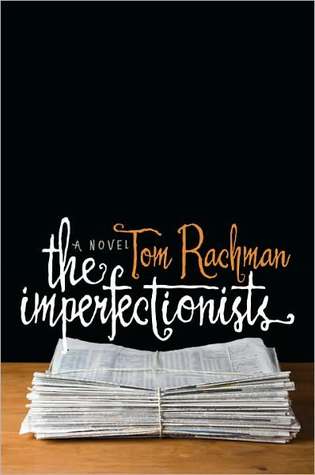
The Imperfectionists by Tom Rachman

Years ago, I lent The Imperfectionists to a friend and after a while, I stopped expecting it back. Then one day, as we were making conversation at the university, she handed it back to me, much to my surprise. The copy she gave me was clearly new and she looked somewhat embarrassed. Apparently she had completely ruined the original one by dumping it in water (I can't remember how) and had ordered a new one for me from Amazon. Naturally, I was in awe at her thoughtfulness.

In a way, that story resembles the tone and contents of Tom Rachman's The Imperfectionists. It's a collection of anecdotes that all revolve around an American newspaper in Rome. Each chapter is its own short story almost, but there is also a strong central narrative that pulls the reader forward. Chapters are dedicated to the employees (and a reader) of the newspaper and show the daily life of working at a newspaper - and living in Rome.

Reading The Imperfectionists a second time - something that every reader definitely needs to do - I noticed how different my overall impression was. On my first read through, I found the newspaper well managed, Rome a delight and somehow managed to finish the book feeling that everything worked out in the end. Reading it a second time now, I realized how wrong my initial judgment was. Although there is humor and whimsy, The Imperfectionists has the same menacing overtones as Roald Dahl's work. The stories are fairy tales until they aren't. In one surprising scene, the callous "accounts receivable" finally hits it off with an ex coworker that she had secretly been responsible for sacking. Once they make it to a hotel room, however, the tables turn and the coworker turns out to be something different than the gentleman he seemed.

Many of the individual chapters are brilliant in themselves and I feel that I could read them again even now. The only issue I had was that I find the history of the newspaper dull and perhaps unnecessary. It's dispersed across the book, a few pages after each chapter, but it just doesn't have the same emotional weight as the chapters themselves. So it is inevitably outshone by the amazing stories that form the true core. But don't get me wrong, The Imperfectionists is a wonderful book, one that I'm glad to have back in my bookshelf.

Sunday, April 23, 2017

What If? by Randall Munroe

In 2006, someone sent me a link to a webcomic. Back then we shared links via email and the term webcomic carried the same sense of silly novelty as something like "3D printed shot glass" does today. The comic itself was very unassuming, with three crude stick figures and almost no coloring. The title of the comic in question is simply "Philosophy", and while it does have a certain charm to it, it wouldn't strike anyone as the type of thing that could go the distance. You can find the strip I'm referring to here.

Over ten years later, Xkcd is one of the most famous mediums for popularizing science and Randall Munroe, the mind behind, is a science guru in the mould of Richard Feynman and Bill Nye. In recent years, Munroe has also written a science blog called What If? in addition to his triweekly comics. In it, readers ask absurd questions and Munroe tries his best to answer. The most recent answer (never mind the actual question) starts out: "So you want to give endangered whales powerful electric shocks. Great! I'm happy to help."

What If?, the book version, is a collection of the most popular questions from the first few years of the blog and some excellent new ones. Have you ever wondered what would happen, if you threw a baseball at close to the speed of light? Or if there was a giant portal to space in the Mariana Trench? Chances are you haven't, but that doesn't detract from the supreme readability of Munroe's answers. The book is less intense with the actual calculations than the Internet version, but that also means it won't frighten away students of the humanities.

Xkcd has always had a special place in my heart (and my head presumably). So it's no wonder that I absolutely loved What If?. Munroe has clearly found an audience that adores his humor and wit. To be honest, though, I have no idea how someone would react to it, if they were not familiar with its style. Somehow I feel it would be in everyone's interest to understand science more broadly than just what they teach you in school. Interest in the sciences seems to be declining just as we need it most. Answering frivolous hypothetical questions has never seemed this timely.

Sunday, April 9, 2017

The Undoing Project by Michael Lewis

Daniel Kahneman's Thinking Fast and Slow is probably one of the best non-fiction books ever written. Not only has it sold millions of copies, but it really deserves to be read that much. If you look at the list of best selling books from the past ten years, Kahneman's work sticks out almost grotesquely from things like The Hunger Games and 50 Shades of Grey. There is an element of chance involved to almost all fiction best sellers - word-of-mouth is still the best marketing method and readers are not as rational as they like to think. Thinking Fast and Slow on the other hand was a compendium of the most important ideas in modern psychology put in a somewhat readable package. It became a best seller nonetheless.

Michael Lewis looks at the same subject matter, but from a typically Lewisian angle. The Undoing Project is the personal story of Kahneman and his research partner Amos Tversky and their quest to reform psychology research. It doesn't sound like much of a premise, but as always Lewis is able to create an extremely compelling narrative. Kahneman is an inherently pessimistic intellectual who, as a child, had to hide from the Germans in Nazi occupied France. Tversky is a superstar academic, war hero and socialite. Their paths cross in 1960s Israel and they become one of the most influential duos in academia.

Where Thinking Fast and Slow was strictly about psychology and human decision making, The Undoing Project focuses more on the personalities and lives of the researchers. As I've mentioned previously, I greatly enjoy reading about discoveries from the discoverer's point of view. Researchers don't often make for very entertaining reads, but the depth of Lewis's research ensures that there are always multiple interesting topics to explore. I was surprised to find myself tearing up towards the end; I really didn't expect The Undoing Project to be as soulful as it is. 

Having read The Undoing Project, I was struck by how little we currently take advantage of its insights. High school psychology is (or was, but I'd be surprised if anything had changed) a strange combination of vaguely important historical findings heralded as breakthroughs (Pavlov's dogs, for example) and outright absurd references to theories that have long been dismissed (anything Freud). These are life changing concepts that alter the way we think about ourselves. Why is this not part of the standard curriculum?