Tuesday, May 26, 2015

Tulitodistaja by Lars Kepler

Tulitodistaja, or "The Fire Witness", is a straightforward detective novel from a pair of Swedes behind the pen-name Lars Kepler. And wow, it's been such a long time since I read a detective novel (in Finnish we call them "dekkari" with some affection), and an even longer time since I read one in English. Tulitodistaja was a brief encounter that evoked some excitement, some disgust, some disbelief and some boredom. Its not a bad book, but the way it plays off of almost all cliches now associated with the Scandinavian thriller. There is the dive into an icy river, the attack on an abandoned train warehouse and the tragic violence of older men on younger girls.

The writing is dense and professional, with short paragraphs and shorter sentences. But Kepler (or the "Keplers") make the cardinal error of thinking that a back story is the same as character development. All of the players here are one dimensional takes on what should feel like a dynamic study of human emotion in a suddenly changed world. Most characters are given peculiar traits that make them distinct from one another, just witness the orphanage girls shout at each other. But none of them are properly grounded at any point in the narrative. Most of these girls have one defining trait each, be it anger, denial or squeamishness. The same is true of the protagonist Joona, who is mostly defined by his background. Apart from losing his family, he has precious little actual personality.

So perhaps Tulitodistaja is gripping, at least for the first 200 pages, but it lacks any true depth. At least it is honest with itself; The Keplers' creation is not an accident and their prose is imbued with all the necessary gut wrenching moments that are needed to create a national (or even international) bestseller. I won't go as far as recommend something different to read, the typical audience for this type of literature is not very familiar. However, if you are like me, pick up something genuinely haunting, perhaps The Goldfinch.

Monday, May 11, 2015

Slaughterhouse-Five by Kurt Vonnegut

Slaughterhouse-Five is one of those rare books for me that I can go back to and always find an old friend. I've read Slaughterhouse-Five three times (including this one) and I've somehow been able to find new meaning and metaphor each time. It's a classic in every measure, but for those who are unfamiliar with Vonnegut, Slaughterhouse-Five will more likely baffle on the first read through. It's short. There are elements of metafiction and sci-fi. The narrator is purportedly Vonnegut himself, but proves to be highly unreliable. Slaughterhouse-Five masquerades as a World War II novel, but is something else entirely.

I can't accurately pinpoint the first time I read Slaughterhouse-Five, but it must have been some five years ago. I didn't know what to expect and was inspired by the first half and dispirited (a little) by the second. The prologue is a master study of metafiction in itself, and if I was a grade school English teacher, I would use it as an example of a great short story. Latter parts of the novel are slightly perplexing. Despite its brevity, Vonnegut packed the novel with different and intersecting plot lines. Billy Pilgrim has come unstuck in time - and Vonnegut bobs around, sometimes switching time lines between paragraphs.

Slaughterhouse-Five is a house divided. On one hand, its the tragic story of the bombing of Dresden, during the closing days of World War II. Vonnegut uses his personal experiences to paint a realistic picture of surviving as a prisoner of war. On the other, it's a jumbled sci-fi story of traveling through time into different moments of your life. Billy Pilgrim's self confessed time travel also works as a metaphor for the struggle to create meaning in a post-war world. Black humor simultaneuously perpetuates and hides the narrator's struggle to understand how people not unlike him could consider the death of innocents - in the Dresden bombing and the ensuing firestorm - a succesful operation.

Saturday, April 25, 2015

The Undercover Economist Strikes Back by Tim Harford

Having read The Undercover Economist, I vowed to take some time off from reading the economics equivalent of kitchen psychology. Yet, here I am again. I tried to read some fiction for a change, but for some reason, I haven't been that interested in the usual plot driven novel lately. For the life of me, I can't tell you why. I always promise myself that the next book I pick up will be a classic piece of fiction - I did really enjoy that Steinbeck - but something has kept me back.

So, once again, The Undercover Economist Strikes Back is a fine piece of economics education packed in a neat paperback, buy it at the airport, format. I read it on my Kindle, and I have to say that I won't miss the paper version in any way. I might be interested in scrolling through the reference section later, but that will have to wait. Tim Harford is great at making simple compelling points about complex things and exploring different sides of a difficult topic. He does it here by comparing classical economics and Keynesian economics. And who wins? Nobody in particular because from what I can tell, Harford plays out both sides merits equally.

The narrative is constructed as a dialog, which I though was a little lazy at first. But despite the awkward structure, the dialog between Harford and an imaginary dictator plays out with wit and has some of the best revelations of the story. From a distance, you might not even realize that its a book about macroeconomics. As a friend of mine once said, "It's got graphs that intersect, it must be macroeconomics". You won't find any of that here. The Undercover Economist Strikes Back is text only, even the Phillips curve doesn't get its own little x-and-y plot. Not that I miss any of that. The whole point here is that macroeconomics is difficult. So difficult in fact, that we still have no good ways of thinking about it. So if someone tells you with absolute certainty that monetary stimulus ends recessions, by reading this book you'll know that it's not so simple.

Sunday, March 29, 2015

He eivät tiedä mitä tekevät by Jussi Valtonen

I don't usually review books that I haven't actually finished. Sorry Moby Dick, Trainspotting and The Anthology of British Poetry. But I will make an exception this time, for what is essentially a brilliant work by Finnish writer Jussi Valtonen. "He eivät tiedä mitä tekevät" roughly translates to "They don't know what they're doing" and I wouldn't fault you for expecting a narrative doused in post-millennium hubris and technology paranoia. Many have compared it to Jonathan Franzen's Freedom and I can see why. The similarities are mostly in the way that the subject matter is discussed, not so much the actual content. However, there are a few parallels such as both protagonists involvement in environmental issues.

Although I'm fairly certain that there are under 10 people in the world that have read both, I will go ahead and indulge myself in a few further comparisons. The biggest difference, I felt, was that after almost 500 pages into Valtonen's work, I still couldn't identify with any of the main cast. I found myself hoping for any positive developments, anything that could lift the tone of the novel from somber. But Valtonen gives us nothing to work with. I always felt depressed after reading this book, and however well written, I couldn't force myself to continue.

Perhaps these are not faults, at least in the literary criticism sense. There are redeeming factors aplenty, however. Valtonen's work is ambitious and mostly succeeds with displaying the ills of modern society. The topics range from the effect of technology on our lives to the way that we fool ourselves into believing in a certain world view. It's clever, intelligent and exceptionally thought-provoking. Valtonen has an engaging way of looking into the thoughts and emotions of his main characters, however dark or brooding they may be. I imagine one day "He eivät tiedä mitä tekevät" will be translated to English and when that day comes, I hope fans of Jonathan Franzen will look up and smile; they are not alone.

Sunday, March 22, 2015

The Management Myth by Matthew Stewart

The subject of The Management Myth came up in friendly conversation over lunch. But the aftermath was anything but passive. The Management Myth happens to be one of those books (summarized brilliantly in an article in The Atlantic) that has readers with similar backgrounds disagreeing on almost every aspect of its story. On one hand, it's the story of Stewart himself and his explosive career in management consulting. On the other, it's about how management came to be in the first place. Students of business schools will love (or hate) The Management Myth, but other disciplines will find themselves without enough to hold on.

Over the course of a two-fold narrative, Stewart gives us the low-down on the management consulting industry. According to some fairly convincing evidence, we should be wary of the suit-touting consultant who whispers into the ear of chief executives and heads of political institutions. Throughout the book, Stewart makes some extremely convincing arguments and shows how the "science" of management is not a science at all. For me, this was definitely the right time to read this book. Its great support for a course on the philosophy of science.

But there is some silliness involved as well. Especially, I barely made it through the first few chapters on the management teachings of Taylor and others. Nobody takes Taylorism seriously, and probably hasn't taken it seriously in 50 years. Let's just forget about him. Also, not all of his argumentation is as convincing. Stewart makes management consulting out to be the absolute worst profession, but I would have loved to hear some discussion of even a few possible merits. His case is so convincing that those few caveats would not have spoiled it, on the contrary.

Tuesday, March 3, 2015

The Undercover Economist by Tim Harford

I wasn't too keen on reading another non-fiction economics book, especially after Superfreakanomics, Nudge, Thinking Fast and Slow and so on. But I was surprised by how much I enjoyed The Undercover Economist, and how much new insight I got. Overall, it follows more or less the same trajectory as a course on micro-economics that I took in Switzerland last year, but apparently a second time through the basic building blocks of our economy teaches even more than the first.

The Undercover Economist is essentially the story of how the economic and social world around us works. Even if it is not a complete or exhausting look, it offers enough of the basic knowledge to feel like a complete work. I won't be going into a list of things that Harford discusses, but I will say that even pedestrian readers (or social science students, god forbid) will understand the content.

Harford's prose is exacting and full of the type of dry British humor that makes me snicker in public places if I happen to be reading this. In a way, I wish that everyone would read this book, because it is easy to understand, concise and presents a clear-headed look on many things that influence our everyday lives. So many things are said in newspapers that bear little resemblance to fact that most people would benefit greatly from reading The Undercover Economist. And remember, that I'm saying this even though I doubted its value in the first place.

The Spy Who Came in from the Cold by John le Carre

Having watched countless James Bond films, I thought that I had a pretty good idea of what the Cold War was about. The espiongage, the deceit, the double crosses and especially the dark undercurrents that crept over what seemed like a life of glamour, had formed a relatively clear idea in my head of what it was like to live in that era. Now, I'm not the first one to point out that John le Carre does an excellent job of showing a grittier and more realistic side of espionage. But sometimes everyone should be reminded of how things really were.

The Spy Who Came in from the Cold is a brilliant, jarring and especially succint account of a spy's journey from Berlin to Britain and back. The few characters are excellently portrayed in as few words as possible, and le Carre is deliberate in his wording. It made me think of The Bridge over the River Kwai and Dashiell Hammett, a piece of art that has managed to become even more convincing decades after its release. The story is as powerful as ever, but so is the idealogy. In a world once again divided by east and west, The Spy Who Came in from the Cold is a fascinating read.

Monday, January 5, 2015

The Grapes of Wrath by John Steinbeck

I used to read classics on a regular basis. For some reason, however, that has changed in the last few years. Classics are often difficult but rewarding reads that often demand more time than we can afford to throw at them. Last summer, I started Moby Dick and gave up after a few hundred pages. Despite being on vacation then, other activities got the better of me and I still haven't picked it up again. During Christmas vacation I was once again offered a nifty two weeks of time to relax and read something significant.

I chose The Grapes of Wrath partly because I was fascinated with the Dust Bowl of Woodie Guthrie's America, partly because it had been lying around in my book shelf for way too long. I imagine that The Grapes of Wrath would be an unbearable read for someone who is not previously familiar with the history and decade in question. Steinbeck does a brilliant job of interspersing the story with vivid descriptions of life in rural America, but these might lose some of their brilliance if the reader does not understand their context. And you really should consider doing some serious Wikipedia research before reading.

The Grapes of Wrath was an extremely enjoyable experience for me, but I can't really articulate why. In a different state of mind, I might have hated the nitpicky plot points and plodding character arcs. Rose of Sharon was painfully obnoxious in every scene and the realist affiliation made some developments seem obvious. Yet there is something both magical and romantic in the way that Tom Joad drives the family through desperate and dangerous acts. A sort of purity of spirit follows the characters as they act on basic human needs.

For those who can afford the time to truly immerse themselves in the Dust Bowl era and the Great Depression, The Grapes of Wrath is a true masterpiece. It is brilliant to the point of giving me goosebumps and sad as to make me cry. The story of social inequality and injustice is just as relevant today as it was when this seminal work was released.

Monday, December 8, 2014

What the Dog Saw by Malcolm Gladwell

I grabbed What the Dog Saw from my bookshelf just as I was leaving for the airport. Malcolm Gladwell's books typically make for some nice flight reading, and from what I remember from reading What the Dog Saw many years ago, I thought that it would be just as good. Even though my flight was only to Copenhagen, I managed to read this one in one weekend. Granted I did skip some of the more insufferable material, but nobody can blame you for that if its the second time you are reading a Gladwell.

What the Dog Saw is essentially a collection of essays published in The New Yorker, and it definitely reads like it. Chapters are independent pieces, so taking a few minutes to let it all sink in after each story is a good idea. You might feel that you have learned something, if you just hunker it down in a few nights, but you won't remember much afterwards.

Malcolm Gladwell always makes for satisfying reading, but it's not really clear to me how I should approach his work. For pure entertainment value, you can just hop through the books feeling somewhat superior but not really learn anything new. But if you go back and try to meticulously wade through all of the information, you'll always run into some wishful thinking on the authors part and some poorly handled source material. I am not saying that this applies to everything in here, but there is just enough of it to always come out feeling a little bit cheated.

That is not to say that people should avoid reading Gladwell. The stories in What the Dog Saw are great if you always remember that they were first published in a news paper and not in book form. This way you won't feel cheated when you read about Ketchup or Cesar Milan, subjects that should only be acceptable in magazines. I want something more from books, even if it is a paperback, popcorn novel heavy on the kitchen psychology.

Friday, December 5, 2014

Woody Guthrie: A Life by Joe Klein

It might not be easy to explain why I became so fascinated with Woody Guthrie in the first place. He might be Dylan before Bob Dylan, the original hobo musician riding empty cargo trains across the US, but it doesn't really explain why I (and apparently many other people) are drawn to his music and life. One of Guthrie's friends wonders out loud at the end of the biography why people most often ask him about Woody and not the other, even more brilliant, musicians he worked with. Its a small mystery, one that is not completely understood through this otherwise solid piece.

Most people might not have heard the name of Woody Guthrie, but most likely know him by reputation. Remember those cartoons of a ragged traveller hopping trains through rural America? A fiddle or a mandolin strapped around his back and a bag of possessions hung on a stick over his shoulder. That is essentially who Woody Guthrie was at one point in his life and somehow that character has entered the national consciousness of western countries, especially the United States.

In addition to that travelling hillbilly, Woody was many things. An avid reader of just about anything, a brilliant (but not very productive) writer of novels, a painter of storefront signs and a communist. A small man that could charm his way through any situation, but also a capricious and callous man. His family dispersed around the country in the dust bowl era, with only his first wife staying behind in Oklahoma. All of this is a wonderful story not only because Woody is such a fascinating persona, but also because his story is as much the story of the birth of modern day America.

For the most part, Klein does a decent job with the vast amount of material. Woody Guthrie: A Life is somewhere between a facts-only biography and a memoir, but it does sometimes become somewhat tedious to read. Because Klein wants to keep things historically accurate, he is unable to bring enough color to some secondary characters. This is most likely because not that much is known of the many people that entered and promptly exited Woody's life.

Woody's life is as much a history lesson of America as it is of western music. Folk music was not supposed to enter the mainstream. Most of the songs had been sung in churches in the 19th century, or even in the cotton fields of the South. The Dust Bowl and Union activities in the United States are things that I wish I knew more about after reading this account. Pick it up for the description of a legend, but stay for the making of modern society

Wednesday, December 3, 2014

The Cuckoo's Calling by J. K. Rowling

By the time I read The Cuckoo's Calling, everybody knew that there was no Robert Galbraith and that the actual author of this detective thriller was in fact J. K. Rowling. On one hand, I completely understand Rowling's decision to work under a pen name. The Harry Potter saga is the best known book series of the last 50 years. Publishing The Cuckoo's Calling under her own name would have felt almost silly. Rowling would have been left standing in her own sizable shadow.

On the other hand, The Cuckoo's Calling is so good that there should have been no need to hide her identity. The characters are well developed and the plot is exhilarating and contemporary. The prose is vivid and concise. I have no trouble recommending The Cuckoo's Calling for anyone looking for a nice detective story or just a nice description of modern day London.

Once again, I won't go into plot details, partly because I just don't remember the names of the characters anymore. A supermodel falls off the balcony of her home. A retired soldier is paid to investigate her death for signs of foul play. The elements of the story are fairly standard, but they do not really feel that way at any point of the book. Once again, I will credit Rowling's ability to conjure complex situations in few words with some of the success.

It should be mentioned, though, that The Cuckoo's Calling is not exactly high literature. It is not Great Expectations, and it might not even be Red Harvest. But in it's own category, detective fiction, Rowling does a flawless job of creating a compelling and altogether delightful read. As a bonus, if you don't enjoy the main character, just imagine that it is Harry Potter during a stifling middle age crisis.

Tuesday, December 2, 2014

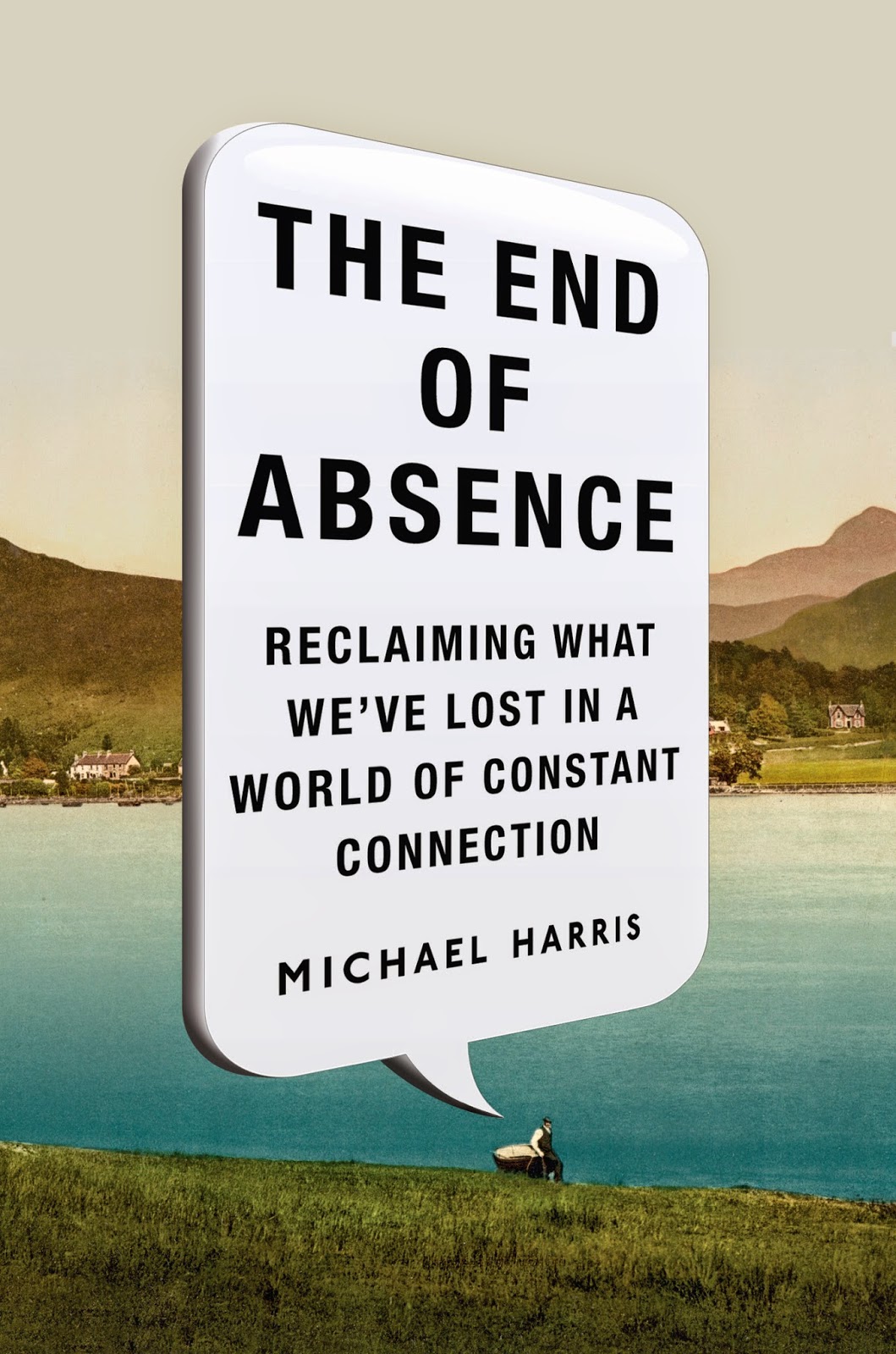
The End of Absence by Michael Harris

With the current backlog of books to be reviewed, I'm having trouble remembering the exact order in which I read them. The End of Absence, a perfectly nice book, is one of those that I am unable to accurately pinpoint on my literature timeline. Did it come before or after The Cuckoo's Calling? I really don't remember. This does not mean, however, that The End of Absence is forgettable or poor. I quite enjoyed reading it, with a few minor exceptions, and felt that I genuinely learned something new.

I guess it was perfectly suiting that I decided to buy The End of Absence after reading a positive review of it in The Economist. A few years ago, I would have had to order it from another country. Now I could just download it to my Kindle with a few taps of my thumbs. The End of Absence is, in a way, the story of that change in the way we live our lives.

It is something that has affected almost everyone's life in the western world. We now have access to most of the world's knowledge everywhere we go. Smartphones help us connect with friends, family, experts and professionals at every moment. The titular End of Absence is exactly that. We are never farther than a few feet from devices that consume our attention better than anything before them.

The best thing about The End of Absence is that it is not a cautionary tale. Michael Harris does a wonderful job of not taking a stand. After all, technological progress is something that we can't stop. We can't turn the clock back to a time before Smartphones or Kindles or Facebook. Progress is a one way street.

The subtitle doesn't do the book any real justice, though. There is no "reclaiming" proposed in this book, the closest that Harris gets to suggesting countermeasures is asking the reader to pause for a moment every now and then to remember the different ways that mobile technology has impacted their life. Has it always been for the best? Are you happier than you were before?

Wednesday, November 26, 2014

SuperFreakonomics by Steven Levitt and Stephen Dubner

Even though I didn't really enjoy Freakonomics (at least when I first read it), I was instantly hooked on the Freakonomics podcast. There is nothing better than sitting on a train listening to well produced podcasts and just relaxing. And because last spring I had plenty of time to sit on Swiss trains, I also ended up listening to most of the Freakonomics podcasts, new and old. This in turn inspired me to read Superfreakonomics, which despite a name that still turns me off, is a fine work. Perhaps even better than its predecessor.

I still consider the podcast to be the best thing that Dubner and Levitt have done, however. For me, the biggest kicks come from the banter between the journalist and the economist, something that is unfortunately absent from the book. Superfreakonomics is by no means devoid of humor, the punch lines are simply better when voiced in turn by the two authors.

I won't be going into the details and stories that make up this work. It continues on the track that Freakonomics set the series on. Therefore, no real surprises to readers of the first entry. And just as before, it really works. I remember Dubner saying in an interview that the book has succeeded if it makes people feel smarter, and that goal has definitely been achieved.

Once again, however, I found the radio equivalent to be more memorable and better paced than Superfreakonomics. The podcasts are so well produced that if you put a camera in front of Dubner and his guests, I am pretty sure it could be shown on TV during Friday prime time (in Finland, at least). Superfreakonomics is great, as I already mentioned, but it probably won't induce heated café conversations between equally unknowleadgable soccer moms in the way that books by Malcolm Gladwell might. And perhaps that is a good thing.

Monday, November 24, 2014

When Genius Failed by Roger Lowenstein

I had to take a long breath when I saw the name of this book in the drafts folder of this blog. It has been almost three months since I finished When Genius Failed and in that time a lot has happened. I did an internship, I volunteered at a start-up event and, finally, took a little vacation. And now, with the title of the book staring at me from behind a monitor, I realize that I remember very little of what happened in this non-fiction finance thriller.

Or perhaps "thriller" is too strong a word. The main characters here are hardly relatable enough to raise feelings of empathy. These are men who have made fortunes through arrogance, guile and occasional backstabbing. They make a series of foolish decisions and are ultimately undone by what amounts to a combination of hubris and bad luck.

When Genius Failed is, apparently, considered a classic of a genre of non-fiction that I might describe as financial failure. So many distinguished books have been published in that category lately - Too Big to Fail by Andrew Sorkin and The Big Short by Michael Lewis to name a few - that I feel Genius barely makes it into the top ten today. This does not mean that it is in any way a bad work, on the contrary. It is only the competition that has upped its game.

When Genius Failed is the story of Long-Term Capital Management, a hedge fund that promptly fails to live up to any of the statements in its name. The highlights of the story include John Merriwether and Myron Scholes, executives of the company who held hallowed positions in finance hall-of-fame. They lost it all in spectacular fashion and Scholes, of Black-Scholes formula fame for those in the know, saw his Noble awarded work in finance greatly devalued. A nice read, but not one I would recommend to anyone off the top of my head.

Sunday, July 27, 2014

World War Z by Max Brooks

World War Z is actually something that I read last summer. At the time, I felt too embarrassed to actually review it, after all it is a dime-a-dozen zombie thriller with a depressing cast of stereotyped characters and little common sense. The most awkward part? I actually liked it back then. In order to determine if it was only a passing craze brought on by living in Vancouver (and oh I miss that place) or actually a decent piece of fiction, I decided to give it another go.

This time the feelings were not so favourable, but overall World War Z is not bad. The author’s vision for a zombie apocalypse is enticing and draws on so many aspects of the global, modern society that it feels (to the degree that a silly zombie book can) plausible. Nations act like they just might in the event of a real conflict. Israel quarantines itself, China denies everything and the USA fails to see the pattern until it is too late. The tales draw heavily on modern political action, which does give the tale some much needed heft.

However, there is no getting around the fact that the overall premise is utter baloney. So many times, I had to skip over a section that felt ridiculous or skim through a chapter that I remembered from last summer. Nothing here is worth reading twice, unless you are once again bored on your summer vacation. There just isn’t that much thematic depth to warrant a reread.


But as I said before, it is in no way a bad effort. World War Z is the only zombie book that I will ever read, and I imagine most of the others to be at least somewhat inferior to this one. World War Z is a comprehensive, imaginative take on what would happen if the dead reanimated and started craving living tissue to eat. For me, however, the “if” in the previous sentence is just too big an obstacle to ever find this book reasonable.

Jailbird by Kurt Vonnegut

The other day, as the film version of Slaughterhouse Five was playing on television, I realized that there is something inherently human and timeless to all of Vonnegut’s work. Cat’s Cradle, The Sirens of Titan and Slaughterhouse Five are all stories that still make perfect sense. "People err", "love thy neighbour" and “Why are we here?” are all powerful topics worthy of inquiry.  And so it is with Jailbird, a touching look at the follies of capitalism and life in general.

Walter Starbuck is a minor criminal implicated in the Watergate scandal and Jailbird is the story of his first day out of prison. Of course, this is Vonnegut, and as Vonnegut always demanded, there is a an autobiographical prologue, references to familiar characters from his other works and a semi-linear structure. Kilgore Trout is once again introduced and quickly discarded, but this time he is the pen name of an inmate not a character per se.

As with many of Vonnegut’s later novels, the ending to the story is versed in small scoops throughout the narrative so that it carries a sort of heft and inevitability. It is a beautifully crafted piece of literature and I kept wondering, how Cat’s Cradle and Slaughterhouse Five typically receive most of the praise, when Jailbird is genuinely this good. No matter, the two aforementioned novels aren’t bad either and, in fact, I look forward to rereading the whole bunch in just a few weeks.


All in all, there is a lot to love about Jailbird. It succeeds on so many levels that I feel like rereading it immediately. It is a story that comes full circle at the end and, for me at least, inspired some soul searching. Nothing serious, mind you, but it does come after your heart from so many angles that it is difficult not to feel a little moved.

Thursday, June 12, 2014

The Winter Journal by Paul Auster


Not too long ago, I harbored a fixation for Paul Auster in the same way that I now have one for Kurt Vonnegut. I read his every book, at least those that were available without too much of a fuss, and enjoyed almost each and every one. Then I read Travels in the Scriptorium, a book so pointless and boring that completely I lost faith. Of course, it has been several years since, and I decided to give The Winter Journal a go. My first thoughts, during the first chapter, were of renewed dissapointment.

The Winter Journal is an autobiographical novel that seems to be a collection of bits and pieces from Auster’s life. Auster talks about his body as a 64 year old man, then he talks about that one time his friend died from a lightning strike. For at least half of the novel, there is no driving force behind the narrative, just a bunch of cookie crums and leftovers. I felt that every time a truly interesting turn appeared, Auster cut it short and moved on to something far less enticing. I mean, how long should a list of the author’s favorite foods go on? Is five pages enough?

The reason I didn’t just dump this one in the nearest waste basket is that there are flashes of brilliance among the mountains of mediocrity. Auster’s record of all the houses he has lived in is remarkable and engaging, on par with his best fiction. Luckily, it takes up almost a third of the book. Also, his prose keeps on getting better over the years. The way that Auster addresses himself as “you” instead of “I” gives surprising depth to some passages. It is an altogether fascinating effect.

It has always been difficult for me to explain what it is exactly that I enjoy about Auster’s work. I heard that his novels have a divisive effect on people, some love him and others don’t. On my side of that line, I see a humanity and humility in his novels that is atypical for almost anyone else. They feel real in the way that a walk in the woods feels real. And just as with a walk in the woods, some people crave the familiar to arrange their own thoughts. In a way, Auster does exactly that. He speaks of “you” instead of “I”.

Tuesday, June 10, 2014

And So It Goes, Kurt Vonnegut: A Life by Charles J. Shields

I imagine that anyone who has ever held a Vonnegut novel, even in high school, even in a bookstore, has felt that they know the author, at least on some level. His habit of inserting himself into his books acts as a psychological conduit to understanding the author himself. Or so I thought. It might seem naive that I felt that by reading Vonnegut's novels, I already knew a little bit about the man himself.

Charles Shields' biography of the author shows, first and foremost that, the author, the man and the persona that appears in the books is not the same Vonnegut. As many other novelists, Vonnegut lived a complicated life. A train-wreck left his nephews orphans, which he and his first wife were too eager to adopt (at least informally). His relationships with his two wives were fraught with fights and misgivings, but so was his the relationships with his publishers. Plagued by spells of alcoholism and melancholy, Vonnegut was often sidelined by the literary elite and lambasted in reviews.

The story plays out naturally, with ample exposition for both Vonnegut and his family. Shields does seem to go a bit too harsh on Kurt himself. And So It Goes is by no means a gloating appraisal for Vonnegut's work. At some point I felt that almost all of Vonnegut's novels were described in negative ways. In a way, as a fan of his work, I expected Shields to have something more positive to say.

It seems like a fitting biography for the man that gave us brilliant quotes for both the uselessness of life and its greatness. Vonnegut's life was filled with contradictions. Sometimes, it seams, he went out of his way to anger those around him. For much of the time, he was unhappy with his work, his writing, his family and relatives. But at the same time, he was able to find joy in the minutiae of life in the United States. Whatever the case, it is as important as ever to separate the man from the legend

Tuesday, May 27, 2014

A Dance with Dragons by George R. R. Martin

The fourth season of the television series Game of Thrones is almost at an end. The show has, so far, been extremely faithful to the series of books by George R. R. Martin, of which A Dance with Dragons is the fifth instalment. Most scenes quote the novels verbatim, characters are portrayed almost with an air of secret fandom and shooting locations range from Iceland to Croatia. This is brilliant, of course and the first three books in the series make for perfect TV material. Immersing yourself in the world of Game of Thrones is rewarding in both the short and long-run.

After four seasons on television, Game of Thrones has now almost exhausted the material from the first three books. However, the directors of the show will soon face a serious problem. As I mentioned before, the fourth book, A Feast for Crows, is a whole lot of wandering around by minor characters and almost no plot advancement. Turns out that A Dance with Dragons is more of the same, only with slightly more interesting characters.

The problem is that both A Feast for Crows and A Dance with Dragons are almost void of any actual character development or action. As readers of the other books in the series know, this season of the television show will end with some of the most iconic events of the whole show. At that point of the story, it almost felt like Martin didn't actually need to go any further. Most of the tension had been resolved - at least from a narrow point of view - by some of the most brilliant turns of events I can imagine.

Not only is A Dance with Dragons extremely slow in its pacing, it is also excruciatingly long. I can only imagine what it must feel like to read this brick of a book without a Kindle. A Dance with Dragons doesn't even feature dragons for the first 1000 pages and even then they only spew some fire and bugger off. Most likely, Martin is facing some trouble tying all the plot lines together and resolving the more minor conflicts. Who can blame him? The task of keeping track of all the events, characters and locations is almost beyond any one man at this point.

There have been some indications that the show might catch up to the novels before Martin has time to finish the sixth book. This might actually be a good thing. If Martin has all of the action lined up for the rest of the story, why not let the brilliant TV crew do what they do best. Enthusiasm for the show is soaring, and rightfully so. In a queer turn of the tables, a television show shows more potential than its literary counterpart.

Thursday, May 1, 2014

Carter Beats the Devil by Glen David Gold

A friend of mine mentioned Carter Beats the Devil when we were discussing recent movies about magicians (Now you see me, The Prestige etc.). He wondered whether or not there might be a movie about it, since he found it "cinematic". Well, turns out there might be a movie version. There definitely should be one. Carter Beats the Devil is an entertaining read with a huge amount of detail, depth and heart.

Charles Carter, a real historical person, is deployed here in a fictionalized version of his life, from young boy to grown man. There are elements of a typical bildungsroman as well as a strong current of change-of-the-century wonder. The world evolves wonderfully around Carter, as he travels the world, first in the bowels of a travelling circus and later as the headliner of his own show. There are setbacks and lucky circumstances, love and loss, all of which is deftly handled by Gold.

The fiction here is so close to the actual history that it is sometimes hard to tell which parts are pulled from an encyclopedia and which parts are conjured up by the writer. Americans might be more familiar with the relevant history, but I had a hard time figuring out if Warren Harding had actually been murdered or if he was a president of the United States in the first place. Also, the book is rife with celebrity cameos (as I can imagine the movie will be), but most of these slipped my attention. Am I supposed to know that the Marx Brothers performed as "Fun in Hi Skule" at one point of their career? Maybe not, but a little complementary knowledge won't hurt future readers.

The attention to detail is amazing, though, as is the way Gold is able to "show, not tell" his way around tricky character interactions and subplots. The narration is subtle and rewarding, the character arcs realistic and thoughtful. Despite all the magic and sleight-of-hand, I did not feel cheated in any way, even when some plot twists initially seemed absurd.

As with some previous books mentioned here, my only problem was the drawn out conclusion. The finale appeared to be written with only one thing in mind - a transition to the big screen. It doesn't serve the narrative well and takes too much of the readers time describing the twists and turns of... well I won't tell. But, this is a minor gripe, since I was genuinely glad I read Carter beats the devil. In my mind, though, it might make a better television series - à la Sherlock - than a single two hour movie. The exquisite characters and the wonderful attention to historical detail are what drives this literally wonderful novel.