Sunday, May 13, 2018

Alexander Hamilton by Ron Chernow

It's been over two months since the last time I wrote. You would be forgiven for thinking that I had taken a longer leave from reading or had given up all together. It's true that it has been a while since I last read something that really got to me. For the last year, I've sometimes felt that I'm running out of steam. Reading hasn't given me as much joy as before. Those are not the reasons for such a long break, however. I've been inching through two tomes of epic length simultaneously: Ron Chernow's Alexander Hamilton and Paul Auster's 4 3 2 1 (more on that in the next post). Combined, they make up over 2000 pages. When traveling, you can only take one with you, as the combined weight from the two would surely push your luggage over the weight limit or break the seams of your backpack.

Alexander Hamilton is, naturally, the biography of the United States' first Secretary of the Treasury. Born out of wedlock in the West Indies, Hamilton rose to key roles in the American Revolutionary War, the Declaration of Independence and the cabinet of George Washington. After years of hard-fought political battles, Hamilton died in a duel with the Vice President Aaron Burr. More than any of his fellow founding fathers, Hamilton's life was a roller coaster of great heights and astounding lows. Even as he left his indelible mark on the country - writing the Federalist Papers, creating the Post Office, the Coast Guard, the Bank of New York, The National Bank and establishing New York as the center of finance and commerce that it still is today - his legacy has often been shrouded by attempts by his detractors to discredit him.

Alexander Hamilton bears some striking similarity to today's world. The first thing you notice is the utter likeness of the 18th century political world to the current one. Political slander in the 18th century was as vicious as it is today with the confounding factor that key members of the president's circle used pseudonyms to trash talk each other in the press. For example, Thomas Jefferson eagerly spread false rumors that Hamilton vied to create a US monarchy and that he was embezzling money as Secretary of the Treasury. The same conflicts that haunt today's America are there as well: the divide between the rural populace and the cities, the feud between the north and the south and the fear of giving too much power to a central government.

Chernow's book is a wonderful work; an enlightening and engrossing read that isn't afraid to ransack archives to prove a point or unearth some new piece of evidence. His prose is pristine and his personal passion for the topic shines through constantly. Quotes from the time slow down the pace a little, but are a critical component in understanding the era which, despite seeming eerily similar to our own at times, is often bewildering in its beliefs, customs and systems.

The last piece of this puzzle is the extraordinary musical Hamilton by Lin Manuel Miranda. It may be mostly unknown outside of the United States, but it has been a source of endless inspiration for me. I would never have read Chernow's biography, if I hadn't listened to the musical on repeat for the last two years. I am unable to say, which of the two should be considered the main oeuvre and which is more a supporting work. Even as the musical is based on the book, it transcends it in every way. The biography hints at the connection to today's America; the musical blows it wide open. I notice that even in this somewhat lengthy review, I have only said a fraction of the things that I want to say about Alexander Hamilton. His life story is a rabbit hole that ultimately explains the modern world as much as it reveals our history.

Friday, February 23, 2018

Homo Deus by Yuval Noah Harari

It's taken me an unusually long time to find something to say about Homo Deus. I've been struggling to come up with a way of describing it that would both do it justice and elaborate some of my frustrations with it. Just as its predecessor Sapiens, Homo Deus has been received with almost universal acclaim. It has a sense of gravitas and distinction that raises it above many better books. I couldn't quell a feeling of history-in-the-making as I read chapters on the nature of fiction, spiritualism and data, while simultaneously feeling extremely frustrated with Harari's extravagances and general pomposity.

A friend had an accurate description of Homo Deus: if you take everything at face value, you are either extremely gullible or will never finish it. Harari has opinions. You will agree with some and disagree with others. So expecting to read Homo Deus in the same state of mind as you would read something like Alexander Hamilton's biography (as I'm currently doing), will inevitably result in disbelief at the amount of leeway Harari has taken. Parts of Homo Deus recall editorials in science journals and in some ways the book is just several of those strung together.

I've always been a fan of telling stories through examples, and this is where Sapiens and Homo Deus diverge most. Sapiens was a riveting read, because it could enlighten the reader with stories of early humans and modern history. Those stories were the backbone of the book, and served to prop up other, more speculative, parts. Homo Deus is largely devoid of anecdotes, especially toward the end. This is understandable, as Homo Deus has less source material to go on. The future is unwritten, and Harari's goal is to look as far into the future as possible, so theorizing is the more common mode by default.

All this doesn't mean that Harari's message isn't important, even vital. As humans, we are so focused on daily drudgery that slower changes seem not to register. Harari succeeds at taking several steps back and looking at changes that have been brewing for decades or centuries. With the decline of religion and the lure of individualism, humanity has lost its sense of purpose. If there is no god, and humans are mostly (or wholly) algorithms that react to changes in their environment, how can there be free will or meaning. These questions have been posed by others before, but Harari ties them into a larger discussion of where humanity is headed. It is an important, but partly demoralizing debate.

More than with any other book, I struggled to give Homo Deus its due. I absolutely loathed reading some chapters. Harari goes on for pages in the style of "By equating the human experience with data patterns, Dataism undermines our main source of authority and meaning, and heralds a tremendous religious revolution, the like of which has not been seen since the eighteenth century.". As important as the message may be, his prose is too overbearing at times and he can't resist shoehorning in his personal opinions (on meat production, for instance). I struggled to finish it, because of its faults. Yet, I have a feeling that Homo Deus will come to mark an end of an era, as artificial intelligence overcomes human intelligence. As a guide to that future, Homo Deus is the undisputed leader.

Tuesday, January 16, 2018

Selected Short Stories by Philip K Dick

Philip K. Dick may be better known to most for the movies based on his novels. “Blade Runner”, “Minority Report” and “The Man in the High Castle” (among many others) have become staples of the science fiction genre and are known to even the most casual moviegoer. “Blade Runner”, especially, is more than a movie: it launched the career of one of the most recognizable actors of his generation (Harrison Ford) and defined the visual esthetics of science fiction in general. The underlying novels and short stories, while less well known, are classics as well. They are often funnier and stranger than their movie adaptations and work as great companions to the movies they inspired.

The short stories in this collection – compiled expertly by Jonathan Lethem – offer an enticing overview of the author’s work. There is an enviable amount of variety in the stories, but they are not all equal. “Second Variety” and “Impostor” are instant classics. “We Can Remember It For You Wholesale” and “Minority Report” are excellent, but better known as high budget action films (the former was retitled “Total Recall” and inexplicably starred Arnold Schwarzenegger). “The King Of The Elves” and “The Electric Ant” are delightful diversions, but don’t necessarily warrant another reading. Even the weaker chapters – namely “Rautavaara’s Case” and “Roog” – have their own role in the ensemble. They work as asides and transitions between the main material.

What stands out is that each short story has merit on its own, yet the collection adds something to each individual piece. Themes of apocalypse, insanity and the nature of reality are observed from different angles to create a surprisingly compelling whole. “Autofac” and “Second Variety” describe a world, where factories have been automated to produce weapons without the intervention of humans. The quest to win wars leaves all sides on the brink of humanity’s end. The last humans desperately look for respite in a world ruled by apocalyptic wastes and bloodthirsty machines. Yet in spite of the chilling and sometimes gruesome content, Dick has a knack for the absurd. Many of the stories have surprising levity, even as they explore serious topics.

If Ender’s Game mostly attracts nerds and military types, Philip K. Dick has a much wider appeal. The science fiction is mostly there as a backdrop to explore humanity's fears and frailties. His descriptions of future technology with gears and wires, clicking and whirring, may seem quaint in our digital world, but the consequences of that technology are depicted disquietingly. Casual readers will quickly pick up on how, half a decade later, humanity is still on the course outlined in these short stories – only we are closer to their future than ever before.

Friday, December 1, 2017

Ender's Game by Orson Scott Card

Ender’s Game is about preteen boys training to become space commanders. There is no way of getting around that. Unapologetically sci-fi, on the surface, Ender’s Game sounds like a poor episode of Star Trek or one of the fictional novels of fictional novelist Kilgore Trout. Once you get past the silly premise, however, Ender’s Game is a brilliant and pleasingly short epic about leadership, war and the (sometimes necessary?) abuse of power.

Andrew “Ender” Wiggin is a child – 6 years old in the beginning – who is drafted to military school in preparation of a third act in an interplanetary war with an alien species, the “buggers”. The school, a space station in close orbit, was once home to his older brother, who was dispelled for his violent and unpredictable character. Unbeknownst to Ender, he has been deemed the only hope to lead humanity’s starships in a last effort against the threat. He is isolated and humiliated by his superiors in an effort to turn him into a ruthless leader.

Described in this way, Ender’s Game may sound dull, even run-of-the-mill. A recent, fairly average, movie seems to indicate the same thing. Undaunted, I followed a friend’s recommendation to read it with an open mind. Once I got past the implausible seriousness of the children – they sometimes speak as if augmented with an elder statesman implant – I started to enjoy Ender’s Game.

I hugely enjoyed the author’s stylistic choices. Science fiction sometimes gets too tangled in trying to explain all the ways an imagined world is different to the one we live in. Card has chosen to give a minimal amount of description about Ender’s surroundings. For example, the space station is described as a rotating doughnut spinning around a central arena, and it’s corridors slope upward as a result. Beyond that, there is little discussion of what it is actually like inside. Card’s focus is instead on Ender’s mind and the relationships of the school’s boys (and few girls). Readers are given just enough context to fill the atmospheric void. As a result, Ender’s Game has aged extremely well: readers are able to substitute the lack of specificity with technology from the current age.

Another triumph is Card’s way of establishing power in the confines of the space station. Power is distributed unevenly between the children. Platoon commanders are responsible for their troops and suffer that responsibility in different ways. Their subjects rebel, submit and try to subvert their commander’s power. Their power is based on superior age, abilities and ruthlessness, not on their skills as a leader.

Power is explored methodically, inch by inch, in a sequence of escalating events that keep the story moving and genuinely affect the children. Even minor characters have credible story arcs as they are forced to live under new circumstances. Yet, the children are defenseless against the power of the school’s adults, who mercilessly intrude on their lives or stay back even when they would be needed.

In its brief 300 pages, Ender’s Game manages to be a coming-of-age story, a leadership guide and an exploration of war. It is mostly self-contained, although it is the first in a long series of stories from the same universe. I was not so enamored with this world to immediately reach for the next book in the series, but it is not out of the question either. Ender’s Game is part Lord of the Flies and part Starship Troopers – extremely serious, but partly absurd. Card walks that fine line well.

Thursday, October 5, 2017

Purity by Jonathan Franzen (revisited)

Reading something twice creates an interesting second perspective. New details emerge, as the reader is free to let his mind wander through a familiar book. Characters may become more believable, when viewed with the benefit of hindsight. Overall, the story may come to make more sense. On the other hand, a second reading may reveal serious flaws that were missed on the first go. As the reader gains familiarity with the material, the suspension of disbelief that hid the most glaring problems may begin to subside. Often, repeated readings reveal the author’s quirks and weaknesses more than new elements of the story.

Rereading Purity had a bit of them all. There were parts that were more enjoyable, because I could look past the immediate storyline and see how the different puzzle pieces fit together. This is true of most books that are worth a second outing: Slaughterhouse-five, Freedom and (surprisingly) A Clash of Kings.

Franzen has once again created a structure that is closer to Pulp Fiction than to Reservoir Dogs – the narrative doesn’t follow a single character and the chapters are not in chronological order. This was frustrating, when I first encountered it, because you are forced to take on new people and places with each new chapter. However, once I was free of the burden of trying to guess how it all fit in, the individual stories seemed more coherent and pleasing.

That being said, it became clearer why Purity didn’t receive the same praise as Freedom or The Corrections. I was especially disappointed to realize that although Purity ought to be about Pip and her travails in the modern world, it is more concerned with practically anyone else. Above all, Purity is the story of Andreas Wolf, the youth worker who becomes a leaker and exposer of secrets. His character arc is enthralling and, at best, visionary, but he is also the villain in a nonconventional sense. More accurately, he is a psychopath and an asshole. While his demise is satisfying, his actions are not. Compared to Richard in Freedom (who has a similar but less creepy role), he is frustrating and, at times, insufferable. Andreas’s motives are sinister or narcissistic, so even his more noble actions are put in doubt.

So here is my list of gripes after a second reading: Pip is the most interesting character, but is left in a supporting role. Anabel and Tom almost get back together despite having an absolutely ridiculous marriage. Tom helps Andreas hide a body, but it is completely out of his character. There is too much talk about masturbation, perhaps by a factor of five. And someone’s mother gets her own backstory of moving out of Germany, but even after a second round, I still have trouble understanding why it is there and whose mother it was in the first place. But as I’ve mentioned before, Franzen has a way of describing the world around us that has always delighted and inspired me. Purity may not be his best work, but it did keep my attention through a second reading.

Thursday, September 7, 2017

Our Kind of Traitor by John le Carré

John le Carré introduced himself as the de facto spy novelist of the Cold War era. His writing, including The Spy Who Came in from the Cold and Tinker Tailor Soldier Spy (both of which were previously featured on this blog), ousted spies as morally ambiguous, traitorous and amorphous. Pop culture had previously been acquainted with only the daring and adventurous detectives in Dashiell Hammett's work and Ian Fleming's high society spy James Bond. Le Carré introduced spying as the ultimate dirty work, where neither side ends up better off. In his work, good men and bad men were equally likely to be found on both sides of the Berlin wall.

The Cold War ended but espionage and intrigue didn't. Le Carré's work has always been rooted in modern fears and fabrications and so it is with Our Kind of Traitor. A Russian oligarch knows that his end is near and begs two Brits to arrange a new identity for him and his family - his information on the Russian mob in exchange for asylum. The Brits, Perry and Gail, play along uneasily at first, but are drawn into a standoff between Dima, the Russian, and the British Secret Service. Perry and Gail are fooled by their own vanity and end up getting a raw deal. The British Secret Service on the other hand is highly dysfunctional and has fractured into rival groups with conflicting agendas.

Despite an ending that felt too familiar from The Spy Who Came in from the Cold, Our Kind of Traitor is a riveting read. It is a perfectly well crafted spy thriller and I am happy to report that physical violence is kept to a bare minimum. This is not a superhero movie, nor a spy novel disguised as one. The characters, especially those of Hector, the spy master, and Perry, the Oxford lecturer turned envoy, are memorable and robust. Men especially will feel tinges of discomfort when reading about Perry's competitive desires and inability to back down.

Le Carré, as always, is the master of international espionage. Other writers put their weight on creating action and suspense through harrowing escapes, car chases and shootouts. Le Carré has instead perfected the slow build-up. Never have I felt so intimidated by a lone Swiss police officer at a train station in Interlaken, or a suave international businessman with an Italian sounding name, who is always nearby when trafficking and money laundering are discussed. Of course, it is all just as fictitious as the shooting and the racing, but for me this is what spies are really about: cold sweat on your back, neglected loved ones or friends and a pervasive uneasiness with the world around us.

Monday, July 17, 2017

Sapiens by Yuval Noah Harari

Sapiens by Yuval Noah Harari is both a phenomenal origin story of the human race and a frustratingly biased and imprecise look at recent history. In much the same way that Bill Bryson opened up the entire history of the universe in A Brief History of Nearly Everything, Harari attempts to reconstruct the development of Homo Sapiens, including everything from our chimpanzee ancestors to our near future. Unlike Bryson, however, Harari has serious problems in keeping the focus on objective observations - and while that may not have been his initial idea in the first place, it becomes a big problem especially toward the end of the book.

Sapiens is at its best early on, when Harari describes the origin of the different Homo-genus peoples. I didn't anticipate enjoying this part of the story so much. Textbook descriptions of hunter gatherer groups have never been able to capture my imagination in the same way as Harari does here. Not only do these chapters succeed in giving a vivid image of how humans lived at the time, but they also highlight the limits of our knowledge in an approachable and realistic way - much of the evidence of early humans has been lost to time. The early nomad expansions into Australia and the Americas are a fascinating example of the determination of early peoples to find new lands. For example, a few centuries after the first humans reached Australia, almost all of the large mammals of the continent disappeared in one of the worst waves of extinction. Before our arrival, Australia had been home to giant kangaroos and marsupial lions.

The largest issues come later on when, Harari describes the industrial age and the modern world. The way he tries to sum up capitalism and science into neat packets does a disservice to the previous few hundred pages. The latter chapters are less an enthralling revisit of history than the author's attempt to shoehorn his own conceptions into pre-existing theories. It is here that Sapiens loses some of its objectivity and credibility.

At one point, Harari claims that economic growth (and the belief in economic growth) are absolutely necessary for banks to take deposits and lend money. This is either a gross simplification or the author's attempt at Zeitgeist-type sleight of hand. I was able to get a mortgage because the bank knows that I have a steady monthly income that I can use it to pay back. This is in no way related to economic growth or the banks expectations that my salary will increase as time goes on. The bank could lend money even in a declining economy (and they do). Finance works (among other things) by smoothing out the immediate need for cash by guaranteeing income in the future.

I am tempted to overlook Sapiens's problems because it did leave an immediate mark on me. The way it looks at the world is quite unique and it will force readers to question even their most fundamental beliefs. Just remember that Harari indulges his whims a tad too much. As a reader, you don't always have to accept his explanations and assertions. Reading Sapiens, you learn much about early humans that you didn't know would be interesting. And you'll be left with a lingering sense that there is still much to learn about yourself and the entire human race.

Tuesday, July 4, 2017

New York 2140 by Kim Stanley Robinson

In 2140, the global water level has risen over ten meters. Coastlines around the world are swept under in "pulses" of rising water and populations counting in the millions are forced to leave everything and search for higher ground. Lower New York is mostly uninhabitable, except for the old skyscrapers,  the first few stories underwater, that have come to resemble Venice. Meanwhile, north of Central Park, "super scrapers" house the super rich. At the MetLife building in Manhattan, a ragtag cast of co-op inhabitants are forced to cooperate to save their building and perhaps the city.

That's the premise for New York 2140, a science fiction (or perhaps "climate fiction") piece by Kim Stanley Robinson. I picked it up, to be honest, because The Verge, a technology website, recommended it. It seems that I've been on the receiving end of book suggestions lately, and so far it's been great!

It's a nice read, but I was a little surprised by what felt to me like a lack of consistency in some of the narratives. Not all of the characters seemed to be acting in a logical way and some of the story choices felt contrived. For example, much of the story revolves around the mysterious disappearance of two young programmers, who had been working on some kind of stock market fix that could end inequality and restore fairness to the economic system. The exact nature of their disappearance is duly explained, but I never understood what it had to do with the rest of the story. A large scale conspiracy is behind most of the events, but it isn't entirely clear how. And most of the conspirators are acting behind the scenes and only mentioned by name in dialogue. The reader is left to imagine the villains based on very limited details.

Luckily, the conspiracy part isn't that important to enjoying New York 2140. Characters like Inspector Gen and Franklin are entertaining and compelling individuals, whose chapters were clear highlights. The dialogue is consistently great - it has wit, charm and keeps the pace wonderfully - and the action is typically at its best when multiple main characters are simultaneously involved. As the novel progresses, this becomes more common, so expect to find a smoother ride after the first half.

As with any book set in New York, the city itself is a towering main character. New York in 2140 is a wonderful amalgamation of Venice, left-wing utopia and modern day New York. The city is in no way a passive player, it seems to act with its own will - it is more than just a backdrop or moody setting. That makes it all the more unfortunate that the author's personal prejudices drive the second half of the action. Robsinson gives his left-wing ideologies a bit too much space, when New York was the real star all along.

Saturday, May 20, 2017

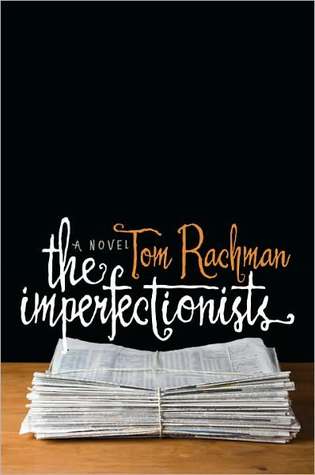
The Imperfectionists by Tom Rachman

Years ago, I lent The Imperfectionists to a friend and after a while, I stopped expecting it back. Then one day, as we were making conversation at the university, she handed it back to me, much to my surprise. The copy she gave me was clearly new and she looked somewhat embarrassed. Apparently she had completely ruined the original one by dumping it in water (I can't remember how) and had ordered a new one for me from Amazon. Naturally, I was in awe at her thoughtfulness.

In a way, that story resembles the tone and contents of Tom Rachman's The Imperfectionists. It's a collection of anecdotes that all revolve around an American newspaper in Rome. Each chapter is its own short story almost, but there is also a strong central narrative that pulls the reader forward. Chapters are dedicated to the employees (and a reader) of the newspaper and show the daily life of working at a newspaper - and living in Rome.

Reading The Imperfectionists a second time - something that every reader definitely needs to do - I noticed how different my overall impression was. On my first read through, I found the newspaper well managed, Rome a delight and somehow managed to finish the book feeling that everything worked out in the end. Reading it a second time now, I realized how wrong my initial judgment was. Although there is humor and whimsy, The Imperfectionists has the same menacing overtones as Roald Dahl's work. The stories are fairy tales until they aren't. In one surprising scene, the callous "accounts receivable" finally hits it off with an ex coworker that she had secretly been responsible for sacking. Once they make it to a hotel room, however, the tables turn and the coworker turns out to be something different than the gentleman he seemed.

Many of the individual chapters are brilliant in themselves and I feel that I could read them again even now. The only issue I had was that I find the history of the newspaper dull and perhaps unnecessary. It's dispersed across the book, a few pages after each chapter, but it just doesn't have the same emotional weight as the chapters themselves. So it is inevitably outshone by the amazing stories that form the true core. But don't get me wrong, The Imperfectionists is a wonderful book, one that I'm glad to have back in my bookshelf.

Sunday, April 23, 2017

What If? by Randall Munroe

In 2006, someone sent me a link to a webcomic. Back then we shared links via email and the term webcomic carried the same sense of silly novelty as something like "3D printed shot glass" does today. The comic itself was very unassuming, with three crude stick figures and almost no coloring. The title of the comic in question is simply "Philosophy", and while it does have a certain charm to it, it wouldn't strike anyone as the type of thing that could go the distance. You can find the strip I'm referring to here.

Over ten years later, Xkcd is one of the most famous mediums for popularizing science and Randall Munroe, the mind behind, is a science guru in the mould of Richard Feynman and Bill Nye. In recent years, Munroe has also written a science blog called What If? in addition to his triweekly comics. In it, readers ask absurd questions and Munroe tries his best to answer. The most recent answer (never mind the actual question) starts out: "So you want to give endangered whales powerful electric shocks. Great! I'm happy to help."

What If?, the book version, is a collection of the most popular questions from the first few years of the blog and some excellent new ones. Have you ever wondered what would happen, if you threw a baseball at close to the speed of light? Or if there was a giant portal to space in the Mariana Trench? Chances are you haven't, but that doesn't detract from the supreme readability of Munroe's answers. The book is less intense with the actual calculations than the Internet version, but that also means it won't frighten away students of the humanities.

Xkcd has always had a special place in my heart (and my head presumably). So it's no wonder that I absolutely loved What If?. Munroe has clearly found an audience that adores his humor and wit. To be honest, though, I have no idea how someone would react to it, if they were not familiar with its style. Somehow I feel it would be in everyone's interest to understand science more broadly than just what they teach you in school. Interest in the sciences seems to be declining just as we need it most. Answering frivolous hypothetical questions has never seemed this timely.

Sunday, April 9, 2017

The Undoing Project by Michael Lewis

Daniel Kahneman's Thinking Fast and Slow is probably one of the best non-fiction books ever written. Not only has it sold millions of copies, but it really deserves to be read that much. If you look at the list of best selling books from the past ten years, Kahneman's work sticks out almost grotesquely from things like The Hunger Games and 50 Shades of Grey. There is an element of chance involved to almost all fiction best sellers - word-of-mouth is still the best marketing method and readers are not as rational as they like to think. Thinking Fast and Slow on the other hand was a compendium of the most important ideas in modern psychology put in a somewhat readable package. It became a best seller nonetheless.

Michael Lewis looks at the same subject matter, but from a typically Lewisian angle. The Undoing Project is the personal story of Kahneman and his research partner Amos Tversky and their quest to reform psychology research. It doesn't sound like much of a premise, but as always Lewis is able to create an extremely compelling narrative. Kahneman is an inherently pessimistic intellectual who, as a child, had to hide from the Germans in Nazi occupied France. Tversky is a superstar academic, war hero and socialite. Their paths cross in 1960s Israel and they become one of the most influential duos in academia.

Where Thinking Fast and Slow was strictly about psychology and human decision making, The Undoing Project focuses more on the personalities and lives of the researchers. As I've mentioned previously, I greatly enjoy reading about discoveries from the discoverer's point of view. Researchers don't often make for very entertaining reads, but the depth of Lewis's research ensures that there are always multiple interesting topics to explore. I was surprised to find myself tearing up towards the end; I really didn't expect The Undoing Project to be as soulful as it is. 

Having read The Undoing Project, I was struck by how little we currently take advantage of its insights. High school psychology is (or was, but I'd be surprised if anything had changed) a strange combination of vaguely important historical findings heralded as breakthroughs (Pavlov's dogs, for example) and outright absurd references to theories that have long been dismissed (anything Freud). These are life changing concepts that alter the way we think about ourselves. Why is this not part of the standard curriculum?

Saturday, February 11, 2017

Olet hyvä tyyppi by Karla Nieminen

"Olet hyvä tyyppi" is a Finnish way of saying someone is a decent person, good company and an overall good guy. It's something of a coveted title. When you discuss recent job openings with a friend, they might say that it's not enough to have the technical expertise, but you also need to be a "hyvä tyyppi". When you describe your new girlfriend to your parents (and she's not there), you say that she's pretty but she's also a "hyvä tyyppi": dependable and genial. The latter is far more likely to impress them.

"Olet hyvä tyyppi" is a guide for better social encounters and relationships. It's a book that I wish I had read five or ten years ago. I had the same kind of engineer attitude to social encounters as the author. Small talk for me was never natural, so I had to come up with a set of rules to follow, if someone caught me off-guard. Reading this, I'm reminded of those first years, when I had to learn it all for myself. This book is a good resource for someone wanting to become better around other people. But I was happy that it never veered towards making yourself better at the expense of others. A zero-sum game is not part of its vocabulary.

A few things stood out. Karla Nieminen's sense of humor is effortless and surprising. She's able to sneak a few great lines in the advice and it genuinely made me smile. An American style version of this book would present the author as an unfaltering relationship guru that has all the answers. Nieminen is much more earnest and human. She makes fun of herself and encourages you to not take yourself too seriously. It feels like she's saying: "I had to learn everything by myself and I'm still not perfect. But I'm happier now and you can be too."

This book seemed to echo what I learned from Bruce Springsteen's memoir. People are almost never faking or putting on an act. When someone complements you, don't question them! When you show genuine interest in them, they will open up and your conversation will be much more lively. I didn't appreciate how different people are until I stopped questioning their intents. Letting go of this idea alone made this book worth the time.

The question at the end of the day is how to make the advice stick. For Nieminen, the answer is simple. You need to practice your skills in the real world until they become second nature. I would like to add to that. Great advice often comes in the form of a story or an anecdote. I've learned some great lessons from novels like The Grapes of Wrath and Freedom, because they make a different kind of imprint in the brain than just saying "now you have to do X differently". So instead of only reading self help books, pick up some classic novels as well. The combination will probably put you on the track to becoming the "hyvä tyyppi" in your own life.

Sunday, February 5, 2017

Born to Run by Bruce Springsteen

Bruce Springsteen is one of the few international rock superstars who has consistently toured in Finland. Many of my friends have seen several of his shows in Helsinki, while other performers of the same caliber are always missed. Springsteen, however, has some kind of special relationship with the fans here. A few years ago, he played an extra 30 minute acoustic show before the actual concert began - and then went on to perform for over four hours with The E Street Band. According to the sources that keep track of trivia such as this, it was the longest concert in his career.

As you can tell, I'm a relatively casual fan of "The Boss". I've never seen him live and I don't own any of his albums. Born to Run (the album) is an amazing piece of rock and roll, but his other albums have never really hit home. I picked up Born to Run (the book) purely based on some positive reviews I'd seen but it really blew me away.

The biggest reason I never completely bought into the whole Springsteen mythos was that I found his lyrics silly and overwrought. I always had trouble believing that the things he was singing about - the cars, the girls, back alleys, small towns - were actually important to him. For some reason, I had always assumed that it was his way of pandering to the American lower middle class. That he wasn't singing with a straight face. How could he be serious?

Turns out that he was serious all the way through. That realisation made me re-examine his music from a whole new perspective. Springsteen has apparently been sincere from the very beginning. He wrote from his heart about the things moved him and lived his life more or less as his songs' characters do. He wasn't trying to fool the gullible working class into buying his albums. He wasn't trying to establish himself as a specific kind of folk hero. It was always about the music, the energy, the freedom and the crowd's reaction to him putting everything he had into his shows.

Underneath all the showmanship and passion, Springsteen was a restless soul and worrywart. He suffered from depression, every time he was forced to retire home from long tours. His soul wanted to be on the road constantly. But he also wanted to have a family, something that his own parents had never been able to provide him with. His father's schizophrenia only became apparent once Bruce was an adult and then it was already too late to truly reconcile.

Sometimes it's difficult to separate the man from the myth. Some will be sceptical of even this work because it might only serve as an attempt to play up the mystery of The Boss. But looking at how he played the marathon set in Helsinki at the age of 65, I'm having a hard time believing that Born to Run doesn't represent who he really is. He even gives a reason for playing those long shows: he's afraid that he's not giving enough, that people will be disappointed. His insecurities can only be put away by playing until the sun goes down.

Friday, December 30, 2016

The Truth About the Harry Quebert Affair by Joel Dicker

When my father bragged about finishing an 800 page book in a week, I was surprised and intrigued. He doesn't read much so I had no idea what kind of book would grab his attention so completely. Typically, I'm not very good at taking other reader's recommendations and I had serious doubts about taking my father's advice. But there was something titillating about The Truth About the Harry Quebert Affair that seemed to tell me that this was no ordinary "affair". I decided to give it a go. (Full disclosure, I read it in Finnish.)

Harry Quebert is a famous novelist and Marcus Goldman, his protege. When the body of a young girl, missing since the 70's, is found on Quebert's property, America is shocked to find out that Quebert's most successful work was based on his relationship with a 15-year old girl. And now the girl's body has been found rotting under the roses of Quebert's  garden. Goldman on the other hand is riding the last ripples of the success of his first novel and dealing with a crippling writers block. When he gets the news of Quebert's arrest, he drops everything and heads to Aurora, a coastal town in New Hampshire, where Quebert has been living for over thirty years.

The premise is simple enough, but the plot is dense and easily keeps the reader's interest through the whole book. The Harry Potters and Millennium sagas of this world may approach similar lengths but often involve multiple storylines that run in circles only to keep the plot going. Dicker is able to build a story that evolves naturally and (mostly) doesn't resort to cheap tricks. The novel feels well rounded and intimate despite its vast scope.

The Truth About the Harry Quebert Affair is a rare work because it is both accessible and profound. On the surface it is a crime thriller, but it never really plays out that way. The story is driven equally by Goldman's personal growth and the labyrinthine social connections of small town America. It succeeds on the strength of its characters - not only Marcus and Harry but the whole ensemble - and the classic story that draws equally from Nabokov's Lolita and Twin Peaks. Unlike other popular murder mysteries of the past years - Gone Girl and Girl on the Train, for example - Harry Quebert is completely un-cynical.

Its biggest success is that it truly grabs the reader from the first pages and doesn't let go. Dicker's storytelling acumen is notable as is his ability to write with humor and wit. Without his ability to bring levity to some mundane plot twists, the novel would read more like a run-of-the-mill detective story than the character study that it aspires to be. Readers will find favorite characters in the large cast, mine was the no-nonsense cop Gahallowood, whose verbal sparring with Goldman make for a great buddy comedy in itself.

Overall, I highly recommend this one. It may or may not endure as a classic of the genre, but for anyone who wants to spend quality time with a book, there is little wrong that can be done by picking up The Truth About the Harry Quebert Affair. As always, I had some minor objections, but listing them here would be a waste of everyone's time. Harry Quebert is so good that even my father read it. In a way, there is no higher praise.

Jumalainen näytelmä by Jarkko Ruutu

Here's something completely different. The autobiography of a notorious Finnish ice hockey player, who recently quit the money leagues. Jarkko Ruutu played in the NHL for the Vancouver Canucks and the Pittsburgh Penguins, among others, and had a spotty career, where he was constantly being sent down to the AHL and then being called back up to the NHL. He played a mean game and was constantly in the news for his fighting, heckling and provocations toward other players. He would do everything he could so that his team could get the other hand in a game.

What makes this book interesting is the way that it portrays a completely different kind of professional sports career. Ruutu isn't loved by everyone. Actually he was once voted the most hated player in the league. His antics put him on the front pages of newspapers, but rarely in a good light. He cherishes his profession but also cries in frustration after games because as his career doesn't always go as planned. Before each season he would make a bet with a friend on the number of penalties that he would get during the season. Ruutu always underestimated his capacity for giving in to his animal instincts. And so every year he would lose that bet. His guesses were never even close.

I was surprised by how poorly his teams were managed (if you take Ruutu's comments at face value). Managers and coaches, both in the NHL and in Finland, treat players as property or assets and give very little attention to actually leading them. The business world has already understood that treating your employees as humans greatly increases output. So why is this so difficult to believe in a sports setting? I imagine that the effect would be even bigger in professional sports, where star athletes put themselves under immense pressure to perform. A prominent Finnish coach gets an especially bad rap. I could only wonder how on earth he could be one of the top dogs with such poor personal skills. His method mostly involved insulting, yelling and playing players against each other.

So grab this for the entertainment value and occasional insight, but don't hesitate to skip passages or chapters entirely. Comments from Ruutu's team mates and coaches add little, and Ruutu's own diary entries mostly show the repetitive and banal side of the sport. Surprisingly, a good companion to this book is YouTube. Television cameras were present for a lot of what is described, and reading about ice hockey only takes you half the way.

Sunday, December 4, 2016

How Not to Be Wrong by Jordan Ellenberg

Mathematics, at it's core, is the act of coming up with a set of rules and using those rules to make deductions that expand their reach. It can be applied to any other aspect of life because, unlike other sciences, mathematics is universal and incontrovertible. Once something has been set in stone in the mathematical world, there is little that can be done to undo it elsewhere. Conversely, a breakthrough in mathematics has often led to surprising developments elsewhere.

Jordan Ellenberg's How Not to Be Wrong is a wonderful look into how mathematics allows us to have a clear understanding of a variety of topics from genetics to lotteries to politics. Above all, it is a universal work, one that demands nothing more than a middle schooler's understanding of mathematics to feel enlightening and insightful.

Ellenberg's style is especially delightful. Experts in many fields take themselves too seriously and treat the reader like an ignorant child. Academic writing is full of obfuscation as researchers try to make their work seem more important and complicated than it really is. Ellenberg manages to reach out to all kinds of readers with prose that is succinct and clear headed. The illustrations are a highlight; one that I won't spoil for any would-be readers.

I have some background in mathematics (a Master of Science with a minor in applied math), so I wasn't really expecting How Not to Be Wrong to challenge me as much as it did. I had heard of Russell's paradox before but Ellenberg introduces the problem through its mathematical history and not as a singular event in time. As with many other science stories (Age of Wonder for one), the context of a discovery is often as important as the discovery itself.

Russell's paradox broadly states that any formal set of rules is bound to give rise to a contradiction. But the story only becomes memorable once you see it from the point of view George Cantor, a fellow mathematician, who had just finished his magnum opus on set theory, only to see his life's work wasted, as Bertrand Russell pointed out his shortcomings. The pressing of the book had to be stopped and an additional line added to it's first page that stated the inherent contradiction built into Cantor's theory. Mathematics would never be the same again.

Friday, October 14, 2016

The McKinsey Way by Ethan Rasiel

I've been having some downtime at work recently. We have a pretty decent library of business books and I decided to put it to good use. The few true business books featured on this blog have been industry hallmarks. They've been enjoyable not only because of the subject matter but also due to the high quality of writing and corporate drama. The world is full of second rate business books that exhibit neither of the above qualities and for the most part I've resolved not to review them here. A few of those have had redeeming qualities - Good Strategy, Bad Strategy comes to mind - but mostly you'll find hackneyed advice that promises way too much. Business writing is very faddish.

The McKinsey Way, in its ultimate brevity, has endured relatively well. It does read like a company brochure at times, but there is enough humor and self-deprecation to ensure the reader doesn't feel like someone is trying to sell them a management consulting project. I am not entirely sure what the ultimate goal of the author was as he no longer works for the company. Is he simply using the company's good name to advertise his own work? I've heard that something similar is wont to happen with Navy Seals, the elite commando team of the U.S. army. Ex-soldiers use the brand for their own purposes, because it always attracts attention if a Navy Seal "reveals the ultimate workout snack" or something similar.

Although The McKinsey Way promises to reveal the techniques used by McKinsey in its consulting engagements, the level of detail is not high enough to actually be useful to copycats. It works better as an introductory course to the industry, for both newcomers and potential customers. It's enjoyable enough because Rasiel has the good sense to joke and question some of the aspects of life at "The Firm". Some of my initial goodwill was undone by the entirely unnecessary chapters towards the end containing tips on "Surviving at McKinsey". In a way they reveal the true audience of this type of literature: the 25-year old Ivy league MBA who travels the country advising CEOs, who still needs to be taught to keep a toothbrush with him when sleeping away from home.

Saturday, October 8, 2016

Cityboy by Geraint Anderson

There was absolutely no reason to reread Cityboy. But I was a bit down on my luck after starting and failing to finish The High Mountains of Portugal by Yann Martel. Life of Pi is one of my all time favorite books (also by Martel), and even the movie is pretty spectacular, so my expectations were way too high. I bought the book on a trip to Portugal and imagined that it would be a breeze. Yet I was wrong, I found The High Mountains of Portugal so tedious that I decided to skip it for good. After a few hundred pages of vague, uneventful landscaping and exposition, I had no will to go on reading.

What I really needed was something that I could pick up without the risk of boring myself to sleep. Cityboy is something I read when I started my studies and I figured it would be a good send off to the corporate life. It's supposed to be a fictional account of the excesses of the banking system, but the cover up is so transparent that it only takes a few tries on Google to figure out that "Scheissebank" is Commerzbank and "Banque Inutile" is Societe Generale. The fact that the main characters name is "Steve" is probably only there to deter lawsuits, such is the extent to which the storyline resembles the authors own life. For all I care, you can read it as an autobiography.

"Steve's" job is to show the reader the extent to which the banking system (as it was before 2008) is corrupt, in-bred and pointless. Bankers make millions of pounds in bonuses just to screw their clients, use drugs and engage in other immoral behaviors. Steve is a utilities-analyst tasked with producing research notes on utilities firms: water, electricity and so on. Some of the material will be genuinely interesting to outsiders, because it's mostly about things that you would never read about otherwise. The banking sector has always espoused opacity, so there are a few precious sequences showcasing the average day in a bankers life that I found enlightening. Pick it up for the fun turns of phrase and stay for the juicy gossip.

The biggest problem with Cityboy is that Anderson himself isn't very likeable, and ultimately seems shallow and moronic. He can pretend to be a left-wing hippie all he want, but actions speak louder than words. Especially at the end, when he ponders the ludicrous amounts of money that he made by hustling clients (but mostly staying on the right side of the law). He promises to give part of the proceeds to charity, but to me that sounds like bull. Talking about giving to charity isn't the same thing as actually doing it. Anderson even tries to create an antagonist in "Hugo", a stuck-up fool of a banker, who somehow manages to get the most votes in industry surveys. But you can't really have an antagonist when there is no one to root for anyway.

Sunday, September 11, 2016

Dark Matter by Blake Crouch

Dark Matter is something I read because I noticed a recommendation for it online. Yes, that's right, book blogs have persuasion power. The end of summer was near and I was looking for one last book to read before the end of the holidays. Dark Matter sounded like something I might enjoy. There was a promise of classic summer sci-fi action combined with some wit and some suspense. Blood Meridian had been such an exhausting experience that I was happy to indulge myself with something much more straightforward and in that category Dark Matter delivered.

A university professor is living a fairly typical Chicago life with wife and child. One night, he is kidnapped, drugged and eventually shipped off into another dimension. Yes Dark Matter is a multiverse story, but a surprisingly uncomplicated one at that. It succeeds mostly because it's uncynical in it's simplicity and genuinely tries to keep all readers engaged. For the most part, you feel drawn to the short thriller. At this point it's only a book, but I could feel the author cutting corners to make the novel ready for a film adaptation.

Readers who are more familiar with other fantasy and sci-fi works will find plenty of similarities to other fiction. For example, the ice world that the protagonists are forced into resembles something extremely similar in a recent popular video game, The Witcher 3. I absolutely loved The Witcher, so I can't really say that Dark Matter has chosen its influences poorly, but parts of the work will feel somewhat derivative to genre veterans. That being said, I went ahead and recommended Dark Matter to a few of my friends. It's fun in the way that vanilla ice cream is fun. As entertainment it's well made, predictable and above all accessible.

Friday, August 5, 2016

Blood Meridian by Cormac McCarthy

I had mixed feelings going in and coming out. Before Blood Meridian, I read The Road and No Country for Old Men, both highly acclaimed novels from Cormac McCarthy. I disliked the former and loved the latter. The Road was too bleak, too unrelatable and I had trouble finding any trace of an actual plot. No Country for Old Men was done well by its film adaptation and was also a pleasing read, closer to a beach read than an artful interpretation. Coming from those two novels, I wasn't sure what to expect from Blood Meridian.

It's an anti-western epic, that follows "the kid" through the Wild West. Indians are scalped for payment, travellers are robbed, women are raped (mostly off-scene) and men murdered. There is a story, but there is also unimaginable violence and it seems that Blood Meridian is more about violence itself than any singular storyline. I can only imagine what it must have felt like to read this in 1985, when it came out. The bloodshed must have been even more distressing then.

Cormac McCarthy's prose is pure treasure. It is as if someone had handed the words down from another realm. Having read Blood Meridian, everything else sounded stale or silly. There is a weight to his words that is rare, even when compared to the very best. Descriptions of the surrounding wilds are what drives the sense of location throughout. Nature is beautiful, but it is also neutral to travellers needs. Watering holes are few and far between, the weather changes unexpectedly. Then again, there are only so many times that you can read about lighting storms and dying of thirst before it becomes a bit predictable and repetitive.

I didn't particularly enjoy the ending and completely failed to understand the epilogue. I was angry at the novel, not for having a somewhat inscrutable outcome, but for not really living up to anything. Some will say that the ending is artful and intriguing but, personally I found it to be an annoyance. You can read into it if you want, it's the stuff of college essays, but it didn't really compliment the rest of the novel and had a somewhat different tone that to me felt like it came from an altogether different novel.